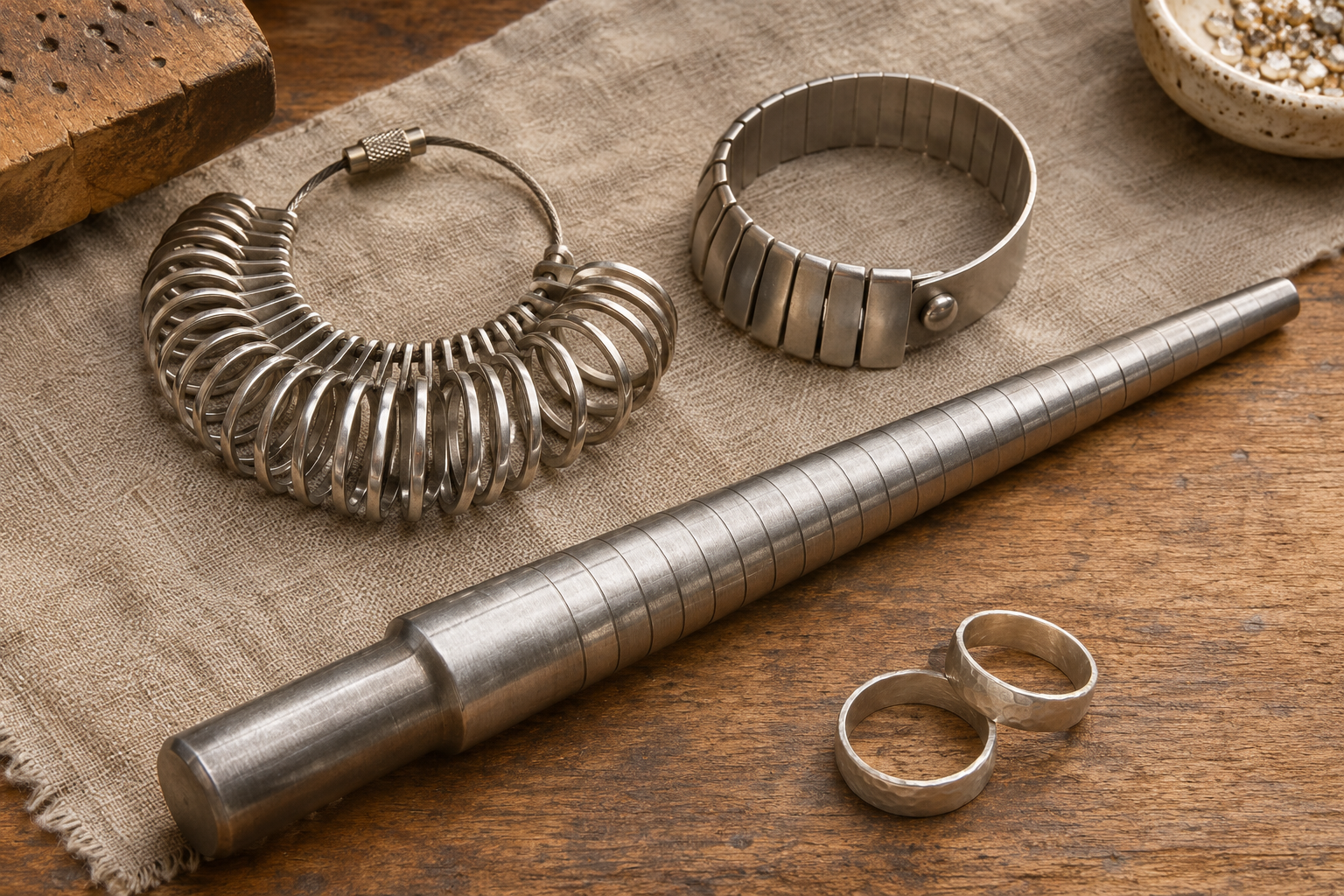
A ring sizer for a finger and a ring stick for a finished band answer different questions. If you make rings for other people, start with finger gauges, then add a marked stick that uses the same size system. For broad bands, use a trial gauge whose width and inside shape resemble the finished ring.
Quick answer
Start with a metal finger gauge set for routine narrow-band fittings and a marked mandrel for checking finished rings. Add a 7 mm wide-band gauge when you make broad bands; use the rounded version for comfort-fit interiors. A plastic set is an inexpensive portable starting point, but confirm important fits with a gauge closer to the finished ring.
Choose a ring sizing tool by job| Your task | Use | Why |
|---|
| Fit a narrow ring to a finger | Metal finger gauges | Repeatable trial rings in half sizes |
|---|
| Fit a broad ring with a flat interior | Flat wide-band gauges | 7 mm width better represents a broad band |
|---|
| Fit a broad comfort-fit ring | Rounded wide-band gauges | Half-round interior models the intended profile |
|---|
| Carry a low-cost fitting set | Plastic finger gauges | Light, chained set for an initial size |
|---|
| Check or form an existing ring | Marked steel mandrel | Reads the ring itself and supports careful bench work |
|---|
A size number only makes sense with its sizing system. These five tools use US markings. Compare them with other countries’ charts only after confirming the conversion; a marked size is more useful than measuring a finger with string and assuming a direct conversion.
The Gold Standard 174.GS set covers US sizes 1–16 in half sizes. Its polished, plated steel gauges make a durable everyday fitting set, and Pepetools makes matching Gold Standard mandrels for transferring the size to bench work. Try more than one adjacent size and check how the ring passes over the knuckle as well as where it rests. A narrow gauge is less representative when the planned band is broad.
Best for routine finger fitting
Pepetools · 174.GS
Pepetools Gold Standard 174.GS finger gauge set
Polished steel finger gauges in US sizes 1–16, marked every half size.
Best for: A standard fitting set that works with matching Gold Standard mandrels.
Specs, strengths and limitations
- Sizing task
- Finger fitting
- US size range
- 1–16
- Size increments
- Half sizes
- Material
- Plated high-carbon steel
Strengths
- Wide size range for a single fitting set
- Calibrated to the maker’s Gold Standard mandrels
Limitations
- Narrow gauges do not simulate a wide band
- Costs more than a basic plastic set
Best for a wide flat band: Contenti 240-506
Contenti’s 240-506 gauges are 7 mm wide and cover US sizes 1–15 in half sizes. Use them when the planned ring has a broad, relatively flat inside. The extra width changes the feel on the finger compared with a narrow gauge. Do not use this set as a stand-in for a rounded comfort-fit interior.
Best for wide flat bands
Contenti · 240-506
Contenti 240-506 wide-band finger gauge set
Seven-millimeter-wide finger gauges for checking the fit of broad, flat bands.
Best for: Fitting wide bands with a flat inner profile.
Specs, strengths and limitations
- Sizing task
- Wide-band finger fitting
- US size range
- 1–15
- Size increments
- Half sizes
- Gauge width
- 7 mm
- Inside profile
- Flat
Strengths
- 7 mm width approximates a broad band
- Half sizes cover the usual fitting decisions
Limitations
- Flat inner profile is less representative of comfort-fit rings
- Does not measure an existing ring
Best for a wide comfort-fit band: Contenti 240-507
The 240-507 set keeps the 7 mm width and US 1–15 half-size range but gives each gauge a half-round inner surface. It is the more relevant trial for a broad ring with a rounded interior. If you make both flat and comfort-fit bands, keep the profiles distinct when recording a customer’s size: the same stamped number may not feel the same on the finger.
Best for rounded wide bands
Contenti · 240-507
Contenti 240-507 wide-band comfort-fit gauge set
Seven-millimeter-wide gauges with a half-round inner profile.
Best for: Fitting broad rings with a rounded comfort-fit interior.
Specs, strengths and limitations
- Sizing task
- Comfort-fit finger fitting
- US size range
- 1–15
- Size increments
- Half sizes
- Gauge width
- 7 mm
- Inside profile
- Half-round interior
Strengths
- Rounded interior models a comfort-fit band
- Wide shape gives a more relevant trial for broad rings
Limitations
- Profile differs from a flat interior
- A second gauge set adds cost to a small bench
Best low-cost portable set: Contenti 240-501
This chained plastic set spans US sizes 1–15 in half sizes. It is inexpensive and easy to carry to a consultation, making it useful for an initial estimate. For a final fit, especially on a wide ring, repeat the trial with a gauge that resembles the planned band’s width and profile. The plastic set does not replace a marked stick for an existing ring.
Best for portable first sizing
Contenti · 240-501
Contenti 240-501 plastic finger gauge set
Plastic finger gauges on a chain in US sizes 1–15 by half sizes.
Best for: A low-cost first measurement or a portable fitting set.
Specs, strengths and limitations
- Sizing task
- Portable finger fitting
- US size range
- 1–15
- Size increments
- Half sizes
- Material
- Plastic
Strengths
- Low cost for an initial fitting set
- Light enough to carry to appointments
Limitations
- Does not reproduce the feel of a wide metal band
- No matching marked mandrel is specified
The 120.GS is a hardened, polished steel mandrel marked US 1–16. Its lengthwise groove provides clearance for a raised setting during careful adjustments, and its marks correspond to the maker’s Gold Standard finger gauges. Use it to read or shape a ring, not to determine a person’s finger size. Hold the ring square on the taper and read the size consistently at the appropriate edge.
Best for existing rings and bench work
Pepetools · 120.GS
Marked hardened-steel mandrel with a groove for measuring and shaping rings.
Best for: Checking an existing ring and making bench adjustments around a raised setting.
Specs, strengths and limitations
- Sizing task
- Existing-ring sizing and forming
- US size range
- 1–16
- Material
- Hardened steel
- Inside profile
- Tapered, grooved
Strengths
- Marked sizes match the Gold Standard finger gauges
- Steel body supports careful forming work
Limitations
- A tapered stick does not measure a finger directly
- Heavier and less portable than the gauge sets
Get a fit you can reproduce
- Choose the correct trial shape. Match the gauge’s width and inside profile to the planned ring as closely as practical.
- Try nearby half sizes. A ring should pass the knuckle without excessive force and sit securely at the base of the finger. Do not infer fit from a single quick pass.
- Note the conditions. If the finger is unusually cold, warm or swollen, repeat the check later before committing to a final size.
- Use a consistent system. Keep the gauge, mandrel and work order in US sizes here. Confirm any chart conversion before cutting a blank.
- Check the finished ring. Read its size on a marked stick, then have the wearer try the actual band when possible. Width, profile and finish can change how it feels.
A ring’s inside diameter is useful for checking a finished piece. It is not the same task as finding the right fit on a finger. Rio Grande’s ring blank chart also accounts for metal thickness and adds allowance for bands wider than 4 mm; use the blank calculation for cutting stock, then confirm the formed ring on your sizing tools.
What to check before ordering
Check the exact model number, US size range, half-size markings, gauge width and inner profile. If you want a finger set and mandrel to agree closely, choose tools from the same calibrated series. Confirm included accessories, shipping and support for your country.
For the broader bench measuring kit, see the jewelry measuring guide. For the rest of a first bench setup, see jewelry bench setup.