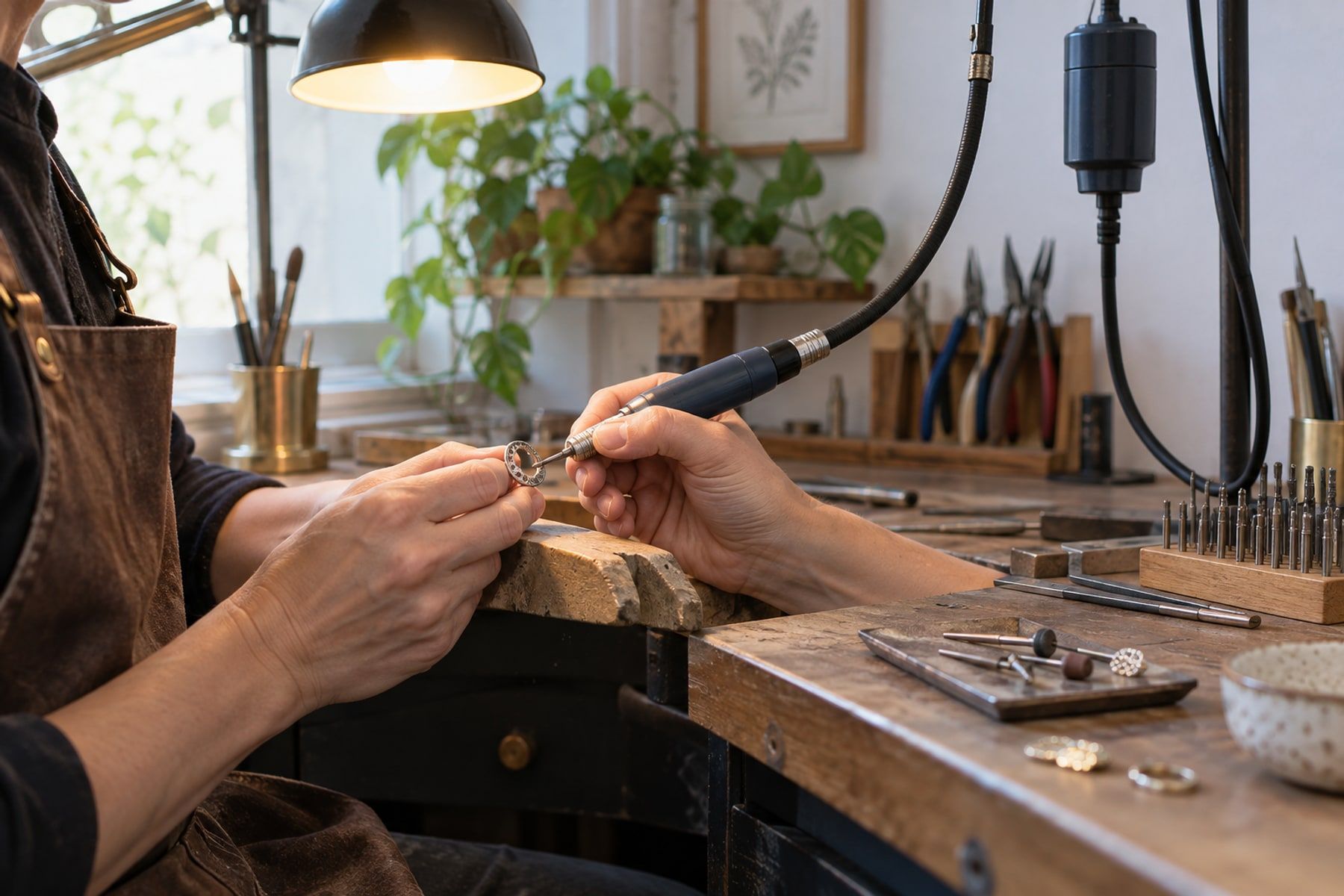
Buying guide
Best Flex Shafts for Jewelry Making
Compare five verified flex-shaft configurations for jewelry making, from budget starter kits to serviceable Foredom and Grobet bench systems.
Workshop section
Learn how to choose a rotary tool for jewelry making, from handheld Dremel-style tools to flex shafts and micromotors, and which setup suits your bench work.
Rotary tools are among the most versatile powered tools on a jewelry bench. With the appropriate bit or attachment, they can drill holes, remove metal, smooth edges, sand surfaces, add texture, clean castings and prepare or polish a piece during finishing.
But “rotary tool” covers several different machines.
A handheld Dremel-style tool, a hanging flex shaft and a bench micromotor may all spin similar burs or abrasive accessories, yet they feel very different in use. The right choice depends less on which machine has the most impressive specification sheet and more on how often you work, what jobs you perform and how much control you need at the handpiece.
For occasional jewelry making, a good handheld rotary tool may be enough. For frequent bench work involving drilling, grinding, sanding and finishing, a flex shaft is usually the more practical long-term setup because the motor’s weight is kept away from your hand.
If you’re deciding specifically between those two options, our flex shaft vs Dremel comparison looks at that decision in more detail.
| If you mainly want to… | Look at… | Why |
|---|---|---|
| Drill, sand or polish occasionally | Handheld rotary tool | Compact, widely available and useful for intermittent work |
| Do regular bench-based jewelry work | Flex shaft | Lightweight handpiece and convenient variable-speed control |
| Work for longer sessions with small rotary accessories | Flex shaft or micromotor | Better handpiece ergonomics than holding a motor body |
| Use different specialist handpieces | Flex shaft system | Many systems support interchangeable handpieces |
| Keep your setup portable | Handheld rotary tool | Easier to store and move |
| Build a more permanent jewelry bench | Flex shaft | Fits naturally into a dedicated bench workflow |
| Buy your first powered jewelry tool on a limited budget | Handheld tool or budget flex shaft | Either can work depending on frequency and intended jobs |
There is no single rotary tool that is automatically best for every jeweler. Start with the work you expect it to perform.
A rotary tool turns a small accessory at speed. The accessory does the actual cutting, grinding, sanding, drilling or polishing.
In jewelry making, that makes the machine useful at several stages of a project.
With a suitable drill bit and chuck or collet, a rotary tool can make holes for components, piercing work or other construction tasks.
The important factors are not simply maximum RPM. Good control matters because jewelry work often involves small workpieces and relatively fine drill bits.
Burs, abrasive points and similar accessories can remove material from metal, refine an edge or reach areas that would be awkward to approach with a larger bench tool.
This is one reason rotary tools become increasingly useful as projects become more complex.
Abrasive discs, drums, wheels and other attachments can help remove scratches, refine soldered areas and progressively prepare a surface for finishing.
Rotary sanding does not eliminate the need for files or hand abrasives. Instead, it gives you another way to handle repetitive or difficult-to-reach areas.
Freshly drilled, sawn or cut metal can have sharp edges or burrs. Small rotary accessories can be useful for cleaning these areas before the next stage of fabrication.
Certain burs, wheels and abrasive tools can also create intentional surface textures.
The machine provides the motion, but the appearance depends heavily on the accessory, pressure and technique rather than the rotary tool alone.
Rotary tools can drive small polishing mops, bristle brushes and other finishing accessories.
They are especially useful for localized work. Larger polishing machines and tumblers perform different roles, so a rotary tool should not automatically be treated as a replacement for every other finishing tool.
A Dremel-style rotary tool combines the motor and spindle in one handheld body.
Its main advantages are simplicity and versatility. You can take it out when needed, fit an accessory and put it away again without committing bench space to a permanent installation.
The compromise is ergonomics.
Because the motor is in your hand, the tool is larger and heavier than a typical flex-shaft handpiece. That may not matter during a short drilling or sanding task, but it can become more noticeable during longer or more precise sessions.
A handheld machine can therefore be a sensible starting point for hobbyists and occasional makers.
For a detailed breakdown of where each approach works best, see Flex Shaft vs Dremel for Jewelry: Which Do You Need?.
A flex shaft separates the motor from the handpiece.
The motor normally hangs above or beside the bench and drives the handpiece through a flexible shaft. Speed is commonly controlled with a foot pedal, allowing both hands to remain involved in positioning and controlling the work.
For jewelry making, the major advantage is that you hold a relatively small handpiece instead of the complete motor.
That can make a flex shaft more comfortable for repetitive bench work such as:
Flex-shaft systems may also support interchangeable handpieces designed for different accessories or types of work.
If you have already decided that this is the type of machine you need, move next to our guide to the best flex shafts for jewelry making rather than choosing solely by motor wattage or advertised speed.
A micromotor is another rotary-tool format often used for fine bench work.
Rather than using a long flexible drive shaft connected to a hanging motor, the motor is incorporated into or close to the handpiece assembly.
The result can be a compact setup with direct speed control and a relatively easy-to-position handpiece.
Micromotors and flex shafts overlap in what they can accomplish, but the feel, torque characteristics, controls, handpiece ecosystem and price can differ substantially.
They are worth considering if rotary work forms a large part of your bench workflow, although beginners do not need to assume that a micromotor is automatically an upgrade over every flex shaft.
It is easy to compare rotary tools by their highest advertised speed because RPM is a prominent specification.
Maximum speed is only one part of the decision.
Different accessories are intended to operate within different speed ranges, and many jewelry tasks benefit more from predictable control than from simply having the highest possible RPM.
What matters is whether the machine provides useful control throughout the speeds you will actually use.
A rotary tool that is easy to control at the bench can be more useful than one chosen purely because its maximum number is larger.
Speed describes how fast the spindle turns. Torque is related to the tool’s ability to keep turning when it is under load.
This becomes relevant when an accessory contacts metal and resistance increases.
A tool that slows dramatically every time moderate pressure is applied can be frustrating even if its no-load maximum speed looks impressive.
That does not mean beginners need the most powerful machine available. It means speed and usable power should be considered together.
For occasional use, the difference between holding a compact handpiece and an entire handheld motor may seem minor.
For repeated jewelry work, it can become much more important.
A slimmer handpiece can offer better access around a small workpiece and may feel more natural when changing angles frequently.
This is one of the strongest practical arguments for a flex shaft when rotary work becomes a regular part of the bench.
Handheld rotary tools commonly use controls on the body of the tool.
Many flex shafts use a foot pedal.
Neither system is automatically better for every situation, but foot control is useful at a jewelry bench because speed can be changed without taking a hand away from the work.
Look beyond whether a pedal is simply included. The useful question is whether the system gives you the degree of control required for the type of work you perform.
The rotary machine is only one part of the setup.
You also need to consider how you will hold:
Some systems use interchangeable collets. Others use chucks capable of accepting a range of shank sizes.
Flex-shaft systems may additionally support specialist handpieces.
Before buying, check compatibility rather than assuming every accessory marketed for rotary tools will fit every machine directly.
A handheld rotary tool is easy to put in a drawer.
A flex shaft generally works best as part of a more permanent bench setup. You need somewhere to suspend the motor, position the shaft correctly and place the speed pedal where it can be used comfortably.
That is not necessarily a disadvantage. A permanent rotary station can improve workflow considerably once you use the machine often.
But it should be planned as part of the bench rather than purchased without considering where it will go.
Our jewelry bench setup guide covers the broader question of arranging tools and work zones around a home jewelry bench.
Any powered rotary tool introduces moving parts.
Build quality can affect vibration, noise, heat and how smoothly the tool feels in operation. Flex shafts also have a drive shaft and related components that may require periodic inspection or maintenance according to the manufacturer’s instructions.
Do not assume that a more expensive tool requires no maintenance, or that every budget machine will perform poorly.
Instead, check:
Those factors matter more as the tool becomes central to your workflow.
Not necessarily.
A beginner making simple pieces can learn a great deal with hand tools before investing heavily in powered equipment.
Files, saws, abrasives and hand drills still teach important control and finishing skills.
A rotary tool becomes more valuable when you repeatedly encounter jobs where powered rotation saves time or gives access that hand tools cannot easily provide.
A handheld rotary tool may be sufficient when:
A flex shaft starts to make more sense when:
You do not need to buy every major bench tool at once. Build the bench around the processes you actually use.
For frequent jewelry bench work, a flex shaft usually has the more suitable form factor because the motor does not sit in your hand.
For occasional work, a Dremel-style rotary tool can be perfectly adequate and may be more convenient.
The difference is therefore less about whether one tool can physically spin a particular accessory and more about workflow.
A handheld tool emphasizes portability and general-purpose use.
A flex shaft emphasizes bench integration, handpiece control and sustained rotary work.
That distinction is explored in considerably more depth in our flex shaft vs Dremel guide.
More RPM does not automatically mean a better jewelry tool.
Control at useful working speeds, torque, handpiece design and accessory compatibility may matter more.
Shank sizes, collets, chucks and proprietary handpieces vary.
Check compatibility before building a collection of accessories around a machine.
A flex shaft can be an excellent long-term bench tool, but a beginner who rarely uses rotary accessories may get little immediate value from the extra expense and installation.
A tool can be powerful and well built yet still be the wrong shape or setup for how you work.
Think about handpiece size, pedal placement, cable or shaft routing and how the machine will sit around your bench.
Rotary tools overlap with files, abrasives, drills and polishing equipment, but they do not replace all of them.
Good jewelry benches usually develop around complementary tools rather than one machine doing everything.
The number of available burs, wheels, brushes and abrasives can be overwhelming.
Start with accessories required for specific jobs instead of buying a large assortment simply because it is inexpensive.
For regular bench work, a flex shaft is often the most practical type because it combines a lightweight handpiece with variable-speed control. A handheld rotary tool can be sufficient for occasional use, while micromotors provide another option for frequent fine rotary work.
Yes. A Dremel-style rotary tool can drill, sand, grind, texture and polish jewelry when used with appropriate accessories. Its main limitation compared with a flex shaft is that the motor remains in your hand, which can be less comfortable or precise during prolonged work.
It can be, but it is not essential for every beginner. A flex shaft becomes increasingly worthwhile when drilling, sanding, grinding or polishing are regular parts of your projects.
A flex shaft is itself a type of rotary tool system. Its motor is separated from the handpiece and drives it through a flexible shaft. A handheld rotary tool places the motor and spindle together in the body you hold.
Variable speed is highly useful because different accessories and tasks call for different operating speeds. Good control is generally more important than simply choosing the machine with the highest maximum RPM.
No. It can speed up many tasks and reach difficult areas, but files and hand abrasives provide a level of controlled material removal and surface preparation that remains important in jewelry making.
Buy for specific jobs. Drill bits, a suitable selection of burs, sanding or abrasive accessories and basic finishing tools cover many common requirements. Check the machine’s chuck or collet compatibility before purchasing accessories.
That depends on how heavily you expect to use it. A budget model may be sufficient for occasional work, while frequent users may place more value on smoother operation, parts availability, handpiece options, serviceability and support. Compare the complete system rather than price alone.
Understand the practical difference between holding a complete rotary tool and working with a separate flex-shaft handpiece.
Use this guide once you have decided that a flex shaft fits your workflow and want to compare suitable systems and models.
Plan where your rotary equipment, lighting, bench pin and other tools should sit before turning a collection of equipment into a permanent workspace.
Read these in order if you are setting up this part of your bench for the first time.
Which tool to buy, and which configuration fits your bench.
Buying guide
Compare five verified flex-shaft configurations for jewelry making, from budget starter kits to serviceable Foredom and Grobet bench systems.
Two approaches or two tools, side by side.
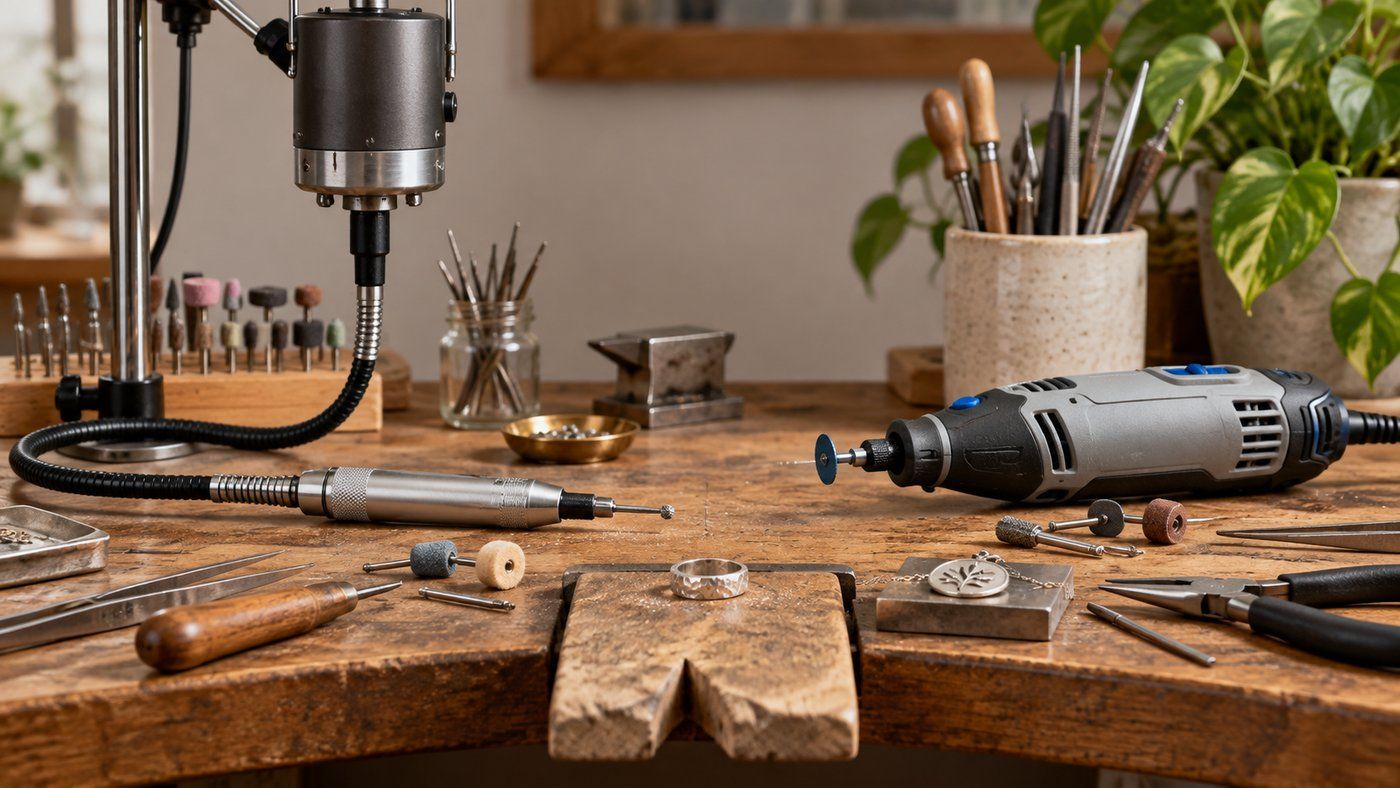
Comparison
Flex shaft vs Dremel for jewelry making: compare control, hand comfort, speed, drilling, polishing, stone setting and cost to decide which rotary tool fits your bench.