Comparison
Magnetic vs Rotary Tumbler for Jewelry: Which Finish Do You Need?
Compare magnetic and rotary jewelry tumblers for burnishing, steel-shot finishing, detailed castings, chain and small-batch jewelry work.
Workshop section
A practical guide to jewelry polishing tools, from flex shafts and bench polishers to rotary and magnetic tumblers, finishing media and ultrasonic cleaning.
Jewelry polishing is not one single operation. A piece may need scratches removed, surfaces refined, edges smoothed, a bright polish produced, recesses burnished and polishing residue cleaned away before it is finished.
That is why there is no single “best jewelry polishing machine” for every bench.
For most home jewelers, the useful distinction is this: use abrasives and rotary tools for controlled surface refinement, a bench polisher when you want faster buffing over larger accessible areas, and a tumbler when you want batch burnishing or access to surfaces that are awkward to polish individually. An ultrasonic cleaner performs a different job again: it cleans residue and contamination rather than creating the polished finish itself.
The right setup therefore depends less on buying the most powerful machine and more on understanding what stage of finishing you are trying to improve.
| If you mainly want to… | Usually look at… |
|---|---|
| Remove scratches, tool marks or uneven surfaces | Files, abrasive paper, sanding discs or rotary abrasives |
| Polish small areas with good control | Flex shaft or handheld rotary tool |
| Buff larger accessible surfaces quickly | Bench polishing motor |
| Burnish rings, chains and batches of suitable jewelry | Rotary tumbler |
| Reach intricate recesses and small detailed surfaces | Magnetic pin tumbler |
| Remove polishing compound, grease and debris | Ultrasonic cleaner or appropriate manual cleaning |
| Produce different stages of finish | Appropriate abrasive and polishing compounds |
These tools overlap, but they are not interchangeable. A tumbler does not normally replace proper scratch removal, and an ultrasonic cleaner does not polish scratched metal.
A useful jewelry-finishing workflow can involve several different stages.
Deep scratches, casting marks, solder seams and uneven surfaces need to be addressed before final polishing.
This is usually the stage where files, abrasive papers, sanding sticks, discs and rotary abrasives do the most important work.
A polishing wheel can make an already smooth surface shinier, but it cannot reliably make poor surface preparation disappear. In some cases, aggressive polishing simply rounds edges while the original defects remain visible.
For beginners, improving surface preparation often produces a larger improvement in the final finish than buying another powered machine.
Once the surface is even, progressively finer abrasives and polishing compounds can reduce the remaining scratch pattern until the desired finish is produced.
A flex shaft gives good control for small areas and individual components. A bench polishing motor trades some of that localized control for speed and convenient access to larger buffing wheels.
The correct choice therefore depends on the scale and geometry of the work rather than simply motor power.
Burnishing smooths and compresses the metal surface rather than removing material in the same way as abrasive sanding.
Tumblers are commonly used at this stage.
A rotary tumbler and a magnetic tumbler can both produce bright surfaces, but their mechanics and strengths differ considerably.
Compare magnetic and rotary tumblers for jewelryPolishing compounds, oils and debris can remain on a piece after finishing.
An ultrasonic cleaner can help remove contamination from suitable jewelry, particularly from areas that are difficult to reach manually, but it should be thought of primarily as a cleaning tool.
It is not a substitute for sanding, polishing or burnishing.
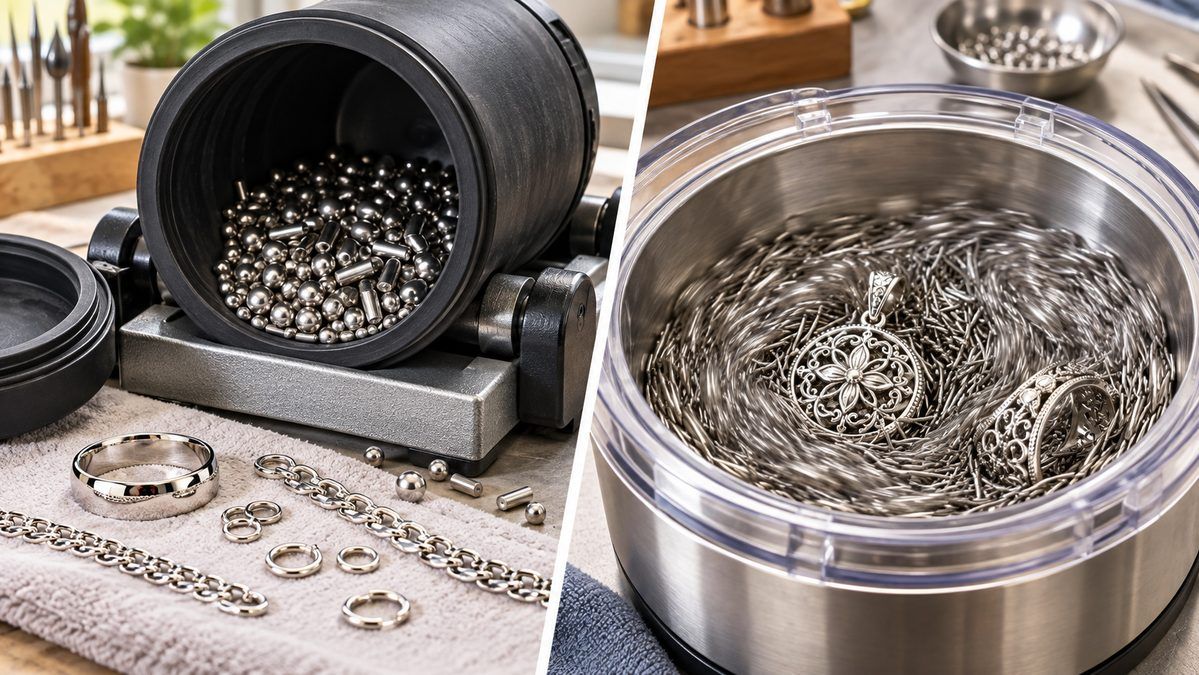
A rotary tumbler uses a rotating barrel containing the workpiece, suitable media and usually a liquid solution.
For jewelry work, stainless-steel shot is commonly associated with burnishing suitable metal pieces. As the barrel turns, the media repeatedly contacts the work and can brighten the surface while reaching areas that would be tedious to buff individually.
Rotary tumblers can be particularly useful when working with:
The important limitation is that tumbling should not be treated as a shortcut around surface preparation.
If a piece contains obvious scratches, filing marks or poorly finished solder areas, tumbling may brighten the metal without removing those defects.
Look beyond advertised barrel capacity.
Consider:
A larger barrel is not automatically better for a small home workshop. Oversizing adds footprint and may require more media while providing little benefit if most batches contain only a few rings or components.
A magnetic tumbler uses a magnetic field to move small stainless-steel pins rapidly around the chamber.
Because the pins are much smaller than conventional rotary-tumbler shot, they can reach narrow recesses, detailed castings and intricate surfaces that larger media may struggle to contact.
This can make a magnetic tumbler attractive for complex jewelry and production workflows involving many small parts.
It does not, however, make the machine universally superior to a rotary tumbler.
A magnetic unit can cost considerably more, and its aggressive pin action may not be the finish you want for every design. Simple work may be handled perfectly well by a conventional rotary tumbler.
The better choice depends on the shapes you regularly make.
Our magnetic vs rotary tumbler guide explains the trade-offs in more detail.
For many small workshops, a flex shaft is one of the most versatile powered tools for finishing.
Mounted abrasive points, radial discs, brushes, rubberized abrasives and small polishing attachments can be used selectively instead of bringing the entire piece to a large polishing wheel.
That makes a flex shaft useful when:
The trade-off is speed. Finishing a large flat surface with a small rotary attachment can be inefficient compared with an appropriately set-up bench polisher.
A flex shaft is therefore often a precision finishing tool, while a bench polisher is more suited to repeated buffing where larger wheels are helpful.
A dedicated bench polisher becomes useful when polishing is frequent enough that repeatedly setting up small flex-shaft attachments becomes inefficient.
Bench polishing machines typically hold polishing or buffing wheels on one or both sides of a motor.
They are especially useful for accessible surfaces where the workpiece can safely be presented to a rotating wheel.
Before buying one, consider:
More power can help maintain wheel speed under load, but a home jeweler should not automatically buy the largest available machine.
Larger motors and wheels require more space and can make delicate work less forgiving.
Polishing speed affects both cutting action and heat generation.
Different wheels and compounds may be intended for different operating conditions, so check the machine and consumable manufacturer’s guidance rather than assuming maximum speed produces the best finish.
Buffing throws compound and fine particles away from the wheel.
A polishing station therefore needs sensible placement and suitable dust control rather than simply an empty corner of the bench.
The motor housing, guards and shaft length affect how easily larger or awkwardly shaped jewelry can approach the wheel.
This can matter more in practice than a small difference in advertised motor specifications.
A polishing motor is only one part of the system.
The wheel, abrasive or compound determines much of the actual cutting and finishing action.
Different compounds are designed for different stages and metals. Some cut relatively aggressively; others are intended primarily to bring a well-prepared surface to a high shine.
The key principle is to avoid jumping directly from a coarse scratch pattern to a very fine polishing compound.
Progressive finishing usually produces a more predictable surface because each stage removes the marks left by the previous one.
It is also useful to keep polishing wheels associated with their intended compounds rather than repeatedly contaminating one wheel with multiple abrasive grades.
Tumblers also depend on the media inside them.
In rotary systems, media choice can change whether the process is primarily burnishing, smoothing or performing another finishing action.
Stainless-steel shot is commonly used when the objective is to burnish suitable jewelry metals. Other abrasive media can perform different jobs.
Magnetic machines typically use fine stainless-steel pins.
Do not assume that media designed for one system should be substituted into another. Check compatibility with the machine, the jewelry material and the finish you are trying to produce.
You usually do not need every polishing machine at the beginning.
A practical starter setup is built around the work you already make.
If you fabricate individual rings, pendants or earrings at a home bench, good files, progressive abrasives and a controllable rotary tool or flex shaft may cover a large part of the finishing process.
A tumbler becomes more compelling when you repeatedly need to burnish chains, findings, batches of small components or difficult-to-reach surfaces.
A dedicated bench polisher makes more sense when polishing volume increases or larger buffing wheels would noticeably improve your workflow.
An ultrasonic cleaner is usually an additional cleaning convenience rather than the first finishing machine to buy.
If you are still planning the overall workspace, see our guide to setting up a jewelry bench at home before adding larger powered equipment.
Powered finishing equipment is most useful when it solves a repeated bottleneck.
You are more likely to benefit from adding a machine when:
You may not need another machine if you only make jewelry occasionally or if the real problem is incomplete sanding and surface preparation.
Buying a tumbler or larger polishing motor cannot compensate for an inconsistent abrasive sequence.
“Polishing” can mean scratch removal, buffing, burnishing or cleaning.
Decide which step is slowing you down before buying equipment.
Burnishing can brighten a surface dramatically, but visible scratches and tool marks may still remain.
Correct them earlier in the finishing sequence.
Power is useful, but control, wheel access, machine geometry, speed and suitable accessories can matter just as much on a jewelry bench.
Large tumblers and polishing motors take more bench space and may not provide any practical advantage for small batches.
Choose around typical work, not hypothetical maximum production.
Wheels, abrasives, compounds, shot and pins are part of the ongoing system.
Check their availability and compatibility before choosing the machine itself.
Ultrasonic cleaning removes contamination. It does not replace abrasive surface preparation or mechanical polishing.
Using the wrong compound, contaminated wheels or an overly aggressive process can undo earlier work.
Keep the progression between stages deliberate.
For many beginners, a controllable rotary tool or flex shaft used with appropriate abrasives and polishing accessories is more versatile than a dedicated polishing machine. Add a tumbler or bench polisher when your normal work gives you a clear reason to do so.
No. Jewelry can be finished without one. A tumbler becomes especially useful for repeated burnishing, batches of small pieces, chains, findings and surfaces that are inconvenient to polish individually.
Not necessarily. Burnishing can brighten and smooth a properly prepared surface, but deeper scratches, filing marks and other defects normally need to be removed during earlier abrasive stages.
Neither is universally better. Magnetic tumblers are particularly useful for fine details and complex surfaces because small pins can reach narrow areas. Rotary tumblers are simpler and can be sufficient for many general burnishing jobs. See our magnetic vs rotary tumbler comparison for the detailed decision.
They solve different problems. A bench polisher is efficient for accessible surfaces and larger buffing wheels, while a flex shaft offers more localized control and works with a wider variety of small accessories.
No. An ultrasonic cleaner primarily removes dirt, oils and polishing residue. It does not perform the same abrasive or burnishing work as a polishing motor or tumbler.
Yes. Excessive abrasive polishing can remove material, soften crisp edges and alter surface details. Use the least aggressive process that achieves the required finish and move through finishing stages deliberately.
A budget machine can be sufficient for occasional work, but price should not be the only criterion. Check whether its size, speed, accessories, replacement parts and working geometry actually suit the jewelry you make.
Understand how rotary barrels and magnetic pin systems differ, where each type works well and why the geometry of your jewelry matters.
Plan where powered tools, lighting, workholding and finishing equipment fit within a practical home jewelry workspace.
As this polishing section expands, this page should remain the starting point for choosing a finishing method. Individual guides can then go deeper into tumbler types, polishing motors, media, compounds and specific equipment without forcing this hub to become a collection of full product reviews.
Read these in order if you are setting up this part of your bench for the first time.
Two approaches or two tools, side by side.
Comparison
Compare magnetic and rotary jewelry tumblers for burnishing, steel-shot finishing, detailed castings, chain and small-batch jewelry work.