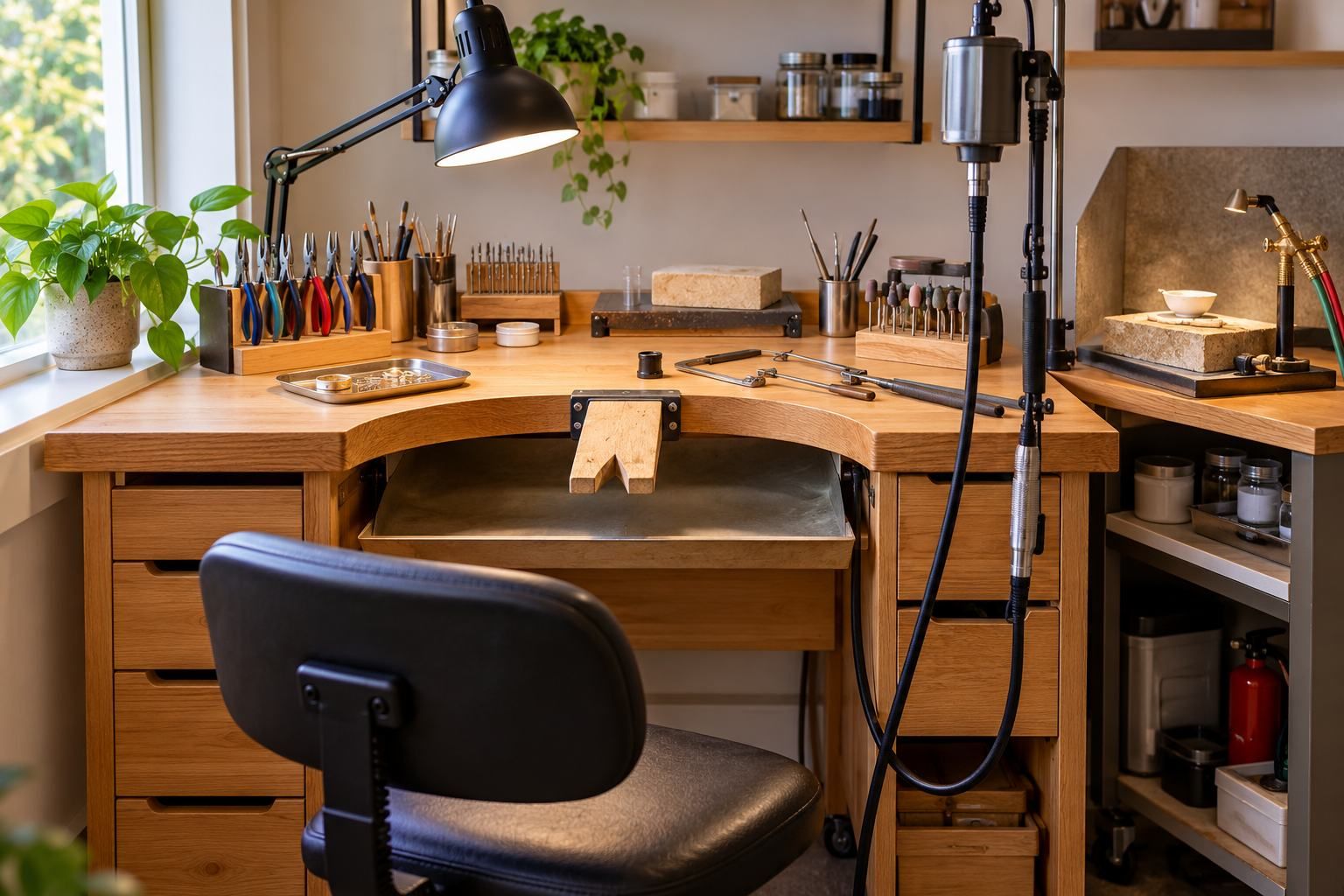
How-to · Bench
How to Set Up a Jewelry Bench at Home: Complete Guide
Set up a jewelry bench at home with the right bench height, bench pin position, lighting, seating, tool layout, metal recovery, soldering zone and safety.
Polishing & FinishingComparison
Compare magnetic and rotary jewelry tumblers for burnishing, steel-shot finishing, detailed castings, chain and small-batch jewelry work.
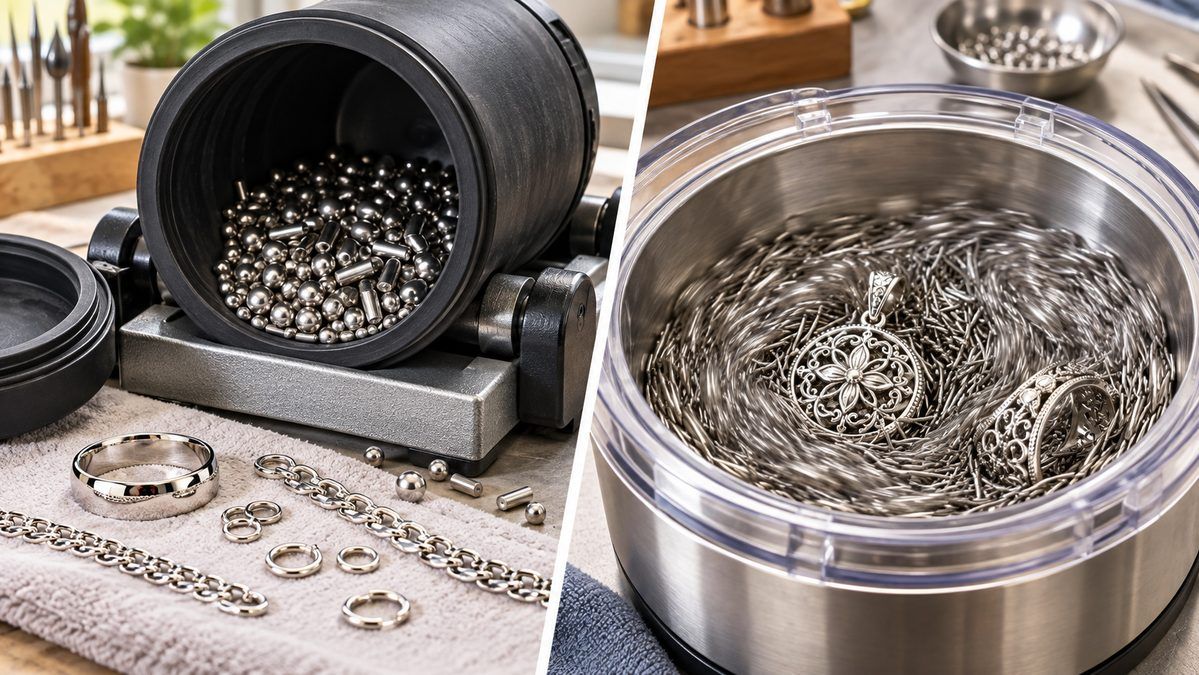
A jewelry tumbler can save a surprising amount of repetitive finishing work, but magnetic and rotary tumblers are not interchangeable machines.
A rotary tumbler rolls the jewelry together with relatively heavy stainless steel shot. That makes it particularly useful for producing an even burnished finish on accessible surfaces.
A magnetic tumbler drives hundreds of fine stainless steel pins rapidly around the work. Those pins can reach between links, around prongs and into recesses that larger rotary media may miss.
That difference matters more than the word “polisher” printed on the machine.
Quick answer
For most home jewelry benches, start with a rotary tumbler and stainless steel shot. It is useful for burnishing chain, wire work, findings and properly prepared fabricated pieces, and it generally produces a stronger overall shine on accessible surfaces.
Choose a magnetic pin tumbler when your main problem is finishing detailed castings, small components, chains, settings and hard-to-reach recesses. Magnetic pins reach places that larger shot cannot, but they may leave a finely peened rather than mirror-polished surface on broad areas.
Neither machine removes deep scratches or poor surface preparation. Sand, file and pre-finish the work first.
| Consideration | Rotary tumbler | Magnetic tumbler |
|---|---|---|
| Media | Stainless steel shot | Fine stainless steel pins |
| Main strength | Overall burnishing | Reaching intricate areas |
| Typical finish | Bright, smooth burnish | Bright, finely peened burnish |
| Broad flat surfaces | Usually better | Can show fine pin texture |
| Deep recesses | Limited by shot dimensions | Excellent access |
| Chain and links | Very useful | Very useful, especially tight areas |
| Detailed castings | Good where shot reaches | Particularly useful |
| Wire findings | Very useful | Possible, but often unnecessary |
| Beginner friendliness | High | More specialised |
| Typical first purchase | Yes | Usually a second finishing tool |
The important distinction is therefore not simply fast versus slow or cheap versus expensive.
It is where the media can reach and what kind of surface it leaves behind.
A rotary tumbler is mechanically simple.
A sealed barrel sits horizontally on powered rollers. As the barrel rotates, the jewelry and tumbling media repeatedly roll over one another.
For jewelry burnishing, the usual setup is:
Mixed stainless steel shot commonly contains shapes such as balls, pins, satellites or other rounded forms. The different shapes help contact different parts of the work.
The shot does not behave like coarse sandpaper.
Instead, the polished steel repeatedly presses and slides against the jewelry surface, burnishing it rather than aggressively cutting it.
That is why rotary tumbling works especially well after you have already removed scratches, file marks and soldering defects.
On appropriately prepared metal, rotary tumbling can create a bright, even burnished finish.
It is particularly effective on:
It can also add some surface work-hardening to suitable fabricated metal components.
That makes rotary tumbling popular for handmade chains and wire findings where the maker wants both a brighter surface and slightly firmer finished components.
Do not confuse this with fully hardening a piece of metal throughout its cross-section, however. Tumbling is a finishing operation, not a substitute for understanding how fabrication, annealing and deformation affect metal hardness.
A magnetic tumbler looks completely different.
Instead of turning the container itself, a motor drives a rotating magnetic field beneath the bowl.
Inside the bowl are:
The moving magnetic field sends the tiny pins rapidly around and against the jewelry.
Because those pins are far smaller than conventional mixed steel shot, they can reach areas that would otherwise be difficult to finish mechanically.
Examples include:
This ability to reach intricate geometry is the major reason to buy a magnetic tumbler.
This is where buyers sometimes have unrealistic expectations.
A magnetic machine can make metal look dramatically brighter, but bright does not automatically mean mirror polished.
The ends and sides of thousands of fine pins repeatedly strike the surface. Depending on the metal, pin dimensions, machine speed and processing time, this can produce a very fine peened or sparkling texture.
On intricate surfaces, that effect may be exactly what you want.
On a large, perfectly flat silver pendant, however, you may prefer the smoother burnished appearance produced by larger rotary shot or a conventionally polished surface.
Experienced jewelers sometimes describe the difference as magnetic finishing producing more of a bright sheen, while rotary steel shot can produce a stronger overall shine.
The distinction becomes most obvious on broad visible surfaces.
Imagine a detailed casting with:
A polishing wheel may reach the exposed face easily while leaving the recesses dull.
A rotary tumbler improves the situation, but its steel shot still has physical dimensions. If the media cannot enter an opening, it cannot burnish the surface inside it effectively.
Magnetic pins are much finer.
They can travel into spaces that ordinary mixed shot cannot, which is why magnetic finishing is particularly valuable for jewelers working with detailed cast pieces.
If you are setting up a home jewelry bench and can buy only one machine, a rotary tumbler is usually the more broadly useful choice.
There are several reasons.
Most beginners make pieces such as:
These generally do not require magnetic pins to reach extremely complicated internal geometry.
What they often benefit from is an easy way to produce a consistent final burnish over several pieces at once.
That is exactly what a rotary tumbler does well.
For burnishing, the basic workflow is straightforward:
Once the variables are understood, the process is repeatable.
A tumbler can also process batches of small components such as:
For a small jewelry business, that can save considerable repetitive bench work.
Magnetic tumblers make more sense when the work itself justifies them.
Cast jewelry can contain recesses and complicated geometry that are awkward to reach with sanding sticks, brushes or conventional polishing buffs.
Magnetic pins can reach many of these surfaces automatically.
Both machines can be useful for chain, but magnetic pins are especially capable of moving between closely spaced links and around detailed structures.
The smaller and more complicated the object becomes, the more useful fine magnetic pins can become.
For occasional jewelry making, spending extra time manually cleaning a difficult area may be acceptable.
If you are repeatedly producing the same detailed casting, those minutes add up.
At that point, a magnetic tumbler is not simply another gadget. It can become a production tool.
If both machines are being used with steel media on properly prepared jewelry, a rotary tumbler with mixed stainless steel shot usually produces the smoother conventional burnish on accessible exterior surfaces.
The heavier shot makes broader contact with the work.
Magnetic pins excel in areas where that larger shot cannot go, but their fine impacts may create a subtly textured surface.
This explains why the two systems are sometimes used together rather than treated as direct substitutes.
For example, a production workflow could use:
Detailed cleaning / burnishing → magnetic pins → overall burnish with rotary steel shot → selective final polishing
That does not mean every jeweler needs both machines.
It means each machine solves a different part of the finishing problem.
Often, yes — but comparing cycle times alone is misleading.
Magnetic finishing is an energetic process. Depending on the machine, piece, metal and desired result, useful changes can happen relatively quickly.
Rotary tumbling typically works more gradually as the barrel continuously rolls the work through its media.
But the machines are doing different things.
A five-minute magnetic cycle and an hour of rotary tumbling are not necessarily alternative ways of producing the same finish.
The correct question is:
Did the process produce the surface you actually wanted?
Always start conservatively and follow the machine and media manufacturer’s guidance rather than copying a cycle time intended for a different machine.
Not reliably.
This is one of the biggest misconceptions around jewelry tumblers.
Suppose a silver pendant still has a visible 400-grit sanding scratch.
Putting it into stainless steel shot may make the surrounding metal brighter, but the scratch has not necessarily disappeared.
In some cases that makes the scratch even more obvious.
The same applies to:
These are surface-preparation problems, and they should normally be corrected before the burnishing stage.
This distinction will make choosing jewelry finishing equipment much easier.
Abrasive finishing removes material.
Examples include:
Burnishing mainly compresses and smooths the surface through contact with polished media.
Stainless steel shot and magnetic pins are primarily associated with this burnishing action.
This is why changing the media can matter as much as changing the machine.
A rotary barrel loaded with abrasive media is performing a different job from the same barrel loaded with stainless steel shot.
So when somebody says a “rotary tumbler removes scratches,” always ask:
What media are they using?
The media explains much of the difference between these machines.
Rotary jewelry tumblers commonly use mixed stainless steel shot.
A mixed assortment helps expose the work to several contact shapes.
Benefits include:
The limitation is physical size.
A piece of shot cannot burnish a recess it cannot enter.
Magnetic finishing uses much finer stainless steel pins.
Their small dimensions allow them to enter narrow areas and move around intricate shapes.
But this creates another problem:
the pins can get stuck.
Particularly risky designs include:
Inspect every piece after magnetic finishing.
A pin accidentally left inside a hollow component is not something you want to discover after the jewelry has been sold.
Treat stone-set jewelry as a special case rather than assuming the whole piece can go into the tumbler.
Some durable stones and secure settings may tolerate carefully controlled rotary finishing.
Other materials may scratch, chip, fracture, lose their polish or otherwise become damaged.
Particularly vulnerable materials include many:
Rio Grande’s rotary tumbler instructions, for example, specifically caution against putting soft materials including turquoise, coral, opal and pearls into the tumbler.
The safest workflow for many handmade pieces is therefore:
finish the metal first → set the vulnerable stone afterward.
If a stone-set piece must be mechanically finished, confirm compatibility for the specific gemstone, treatment, setting and process rather than relying only on the stone family’s name.
Even when the gemstone itself is durable, inspect the construction.
Potential concerns include:
Tumbling repeatedly exposes the jewelry to moving steel media.
If you would not trust the construction under repeated mechanical contact, fix the construction before considering the tumbler.
Yes.
Burnishing changes a surface.
If your design depends on extremely delicate texture, sharp edges or intentional tool marks, excessive tumbling can alter their appearance.
Rio Grande’s guidance for metal-clay finishing similarly notes that longer rotary cycles can progressively flatten fine texture.
So avoid the idea that:
longer cycle = better polish.
Once the desired finish has been reached, more tumbling may offer little advantage.
Be careful.
Steel media repeatedly contacts raised areas of the piece, which can brighten surfaces and modify an intentionally darkened finish.
Sometimes this is useful.
For example, a maker may deliberately oxidize a piece and then burnish selected high points to create contrast.
But if you are trying to preserve an exact patina over the entire surface, test the finishing process first.
It usually will not.
Complete the major surface preparation first.
Contaminated media can produce disappointing results.
Keep the shot, barrel and working solution clean.
Use a suitable burnishing compound and follow supplier directions.
A specialist compound is easier to reproduce consistently than an improvised mixture.
The jewelry and media need room to move.
Follow your machine’s loading limits rather than filling every available space.
A substantial casting repeatedly landing against a delicate component is rarely a good batch combination.
Process compatible pieces together.
Inspect the work.
More time is not automatically better.
Magnetic finishing is excellent for detail, but fine pins can leave their own surface character.
Plan to hand-polish important presentation surfaces if necessary.
Compare pin diameter and length with:
The smallest accessible opening deserves particular attention.
Check the finished jewelry carefully under good lighting.
Machine speed, pin size, chemistry, load and cycle time all affect the result.
Test unfamiliar work rather than placing an entire production batch into a new process.
Both can be useful.
For ordinary handmade chain, a rotary tumbler with steel shot is a very practical finishing method.
It can:
A magnetic tumbler becomes attractive when the chain has very small or complex spaces that conventional shot struggles to reach.
For most beginners making conventional silver chain, I would still buy the rotary tumbler first.
It depends on the casting.
For relatively simple cast forms with accessible surfaces, rotary steel shot can provide an excellent burnishing stage after proper cleanup.
For complicated castings with:
magnetic finishing becomes much more useful.
This is one of the clearest cases where the additional cost of a magnetic tumbler can be justified.
For simple fabricated or cast rings without vulnerable stones, rotary tumbling is generally the more useful all-purpose process.
A magnetic machine becomes interesting when the ring has:
Remember that neither machine automatically creates the final polish on large visible surfaces.
A ring with a highly reflective top surface may still need conventional polishing after mechanical finishing.
For straightforward ear wires, hooks, jump rings and similar fabricated findings, a rotary tumbler is usually sufficient.
It can process an entire batch simultaneously rather than requiring each component to be polished individually.
Magnetic finishing is more compelling when the components have complicated shapes or tiny details.
Yes, and in production environments they can complement one another.
A hypothetical workflow for a complex casting might be:
Experienced jewelers on Ganoksin describe using rotary steel shot after magnetic finishing when they want a smoother burnish on the accessible exterior while retaining the magnetic tumbler’s ability to reach recessed areas.
For a hobby jeweler, though, owning several mass-finishing machines may be unnecessary.
Start by solving your biggest bottleneck.
Do not buy purely by headline capacity.
Think about the typical amount of jewelry and media you actually need to process.
A small barrel is usually sufficient for a home bench producing a handful of pieces at a time.
Jewelry rotary tumblers commonly use rubber or similar lined barrels because they contain wet media and reduce some of the noise produced by moving steel.
Check replacement-barrel availability before buying an obscure machine.
A jewelry tumbler does not need extreme speed.
The goal is controlled cascading movement of the load rather than simply spinning everything against the barrel wall.
Useful replaceable parts can include:
A slightly more expensive machine with easy parts availability may make more sense than a disposable unit.
Do not let a small bag of free media determine your machine choice.
Good stainless steel shot can be purchased separately and may remain useful long after the machine itself has been replaced.
Compare the rated machine capacity with your real production volume.
Buying a large production machine for two rings at a time wastes money and bench space.
Speed control can give you another variable for adapting the process to different pieces and desired finishes.
Many magnetic finishers periodically reverse direction, helping change the movement of the pins around complex work.
Look at what diameter and length of pins the machine supports.
Pin dimensions matter when your jewelry contains small openings.
A magnetic tumbler is mechanically and electronically more complex than a basic rotary unit.
Serviceability therefore deserves more weight when comparing machines.
For a typical beginner or home jewelry maker:
Buy a rotary tumbler first.
It handles a wider share of common jobs for:
It is also an easy introduction to mechanical finishing.
Move to a magnetic tumbler when your work gives you a specific reason to own one.
Typical signals include:
That is a much better purchasing rule than simply assuming the more expensive machine produces the better polish.
For most home jewelers, a rotary tumbler with stainless steel shot is the better first purchase.
It gives you a repeatable way to burnish appropriately prepared jewelry, chain, wirework and batches of small components, and its effect on accessible surfaces is easy to understand.
A magnetic tumbler solves a more specialised problem.
Its advantage is not simply that it works faster. Its advantage is that very fine moving pins can reach surfaces that larger rotary shot cannot.
That makes it valuable for detailed castings, complicated settings and production work where cleaning and brightening difficult recesses has become a bottleneck.
If your pieces are straightforward, you may never need one.
If you repeatedly find yourself staring at a bright casting whose tiny recesses are still dull, a magnetic tumbler starts to make considerably more sense.
Planning a permanent finishing area? Wet processes, polishing debris and precision bench work are easier to manage when they have separate zones. See our guide to setting up a jewelry bench.
A rotary tumbler with stainless steel shot is usually the more versatile first tumbler for a small jewelry bench because it produces a strong overall burnished finish on suitable metalwork. A magnetic tumbler is especially useful for detailed castings, chains, recesses and other areas that fine magnetic pins can reach more easily than conventional shot.
A magnetic tumbler can brighten and burnish metal, particularly in recessed and difficult-to-reach areas. It does not normally replace sanding or polishing on broad visible surfaces, and the fine pins can leave a subtly peened texture rather than a mirror finish.
Some durable stones may tolerate carefully controlled tumbling, but many soft, porous, fractured, treated or organic materials can be damaged. Pearls, opal, turquoise, coral and similarly vulnerable materials should generally be kept out. When uncertain, finish the metal before setting the stone.
No. Tumbling can clean, brighten and burnish a properly prepared surface, but it does not reliably remove file marks, deep scratches or poor solder cleanup. Those defects should be dealt with earlier in the finishing process.
Stainless steel shot primarily burnishes rather than aggressively cuts the metal. Fine surface marks may become less obvious, but visible scratches and file marks should normally be sanded or otherwise removed before steel-shot tumbling.
The fine stainless steel pins used in magnetic tumblers can lodge in small holes, hollow forms, chain links and narrow openings. Check the geometry of the piece against the pin dimensions and inspect every piece carefully after finishing.
Most home jewelers do not need both initially. Start with the machine that solves your most common finishing problem. Rotary tumblers suit general-purpose burnishing, while magnetic tumblers become more useful when intricate castings and inaccessible recesses are a regular part of the workflow.
We have not personally used every product in this guide. Recommendations are based on specifications, manufacturer documentation, specialist references and owner experiences.
Full details: how we review and research tools and oureditorial policy.
How-to · Bench
Set up a jewelry bench at home with the right bench height, bench pin position, lighting, seating, tool layout, metal recovery, soldering zone and safety.