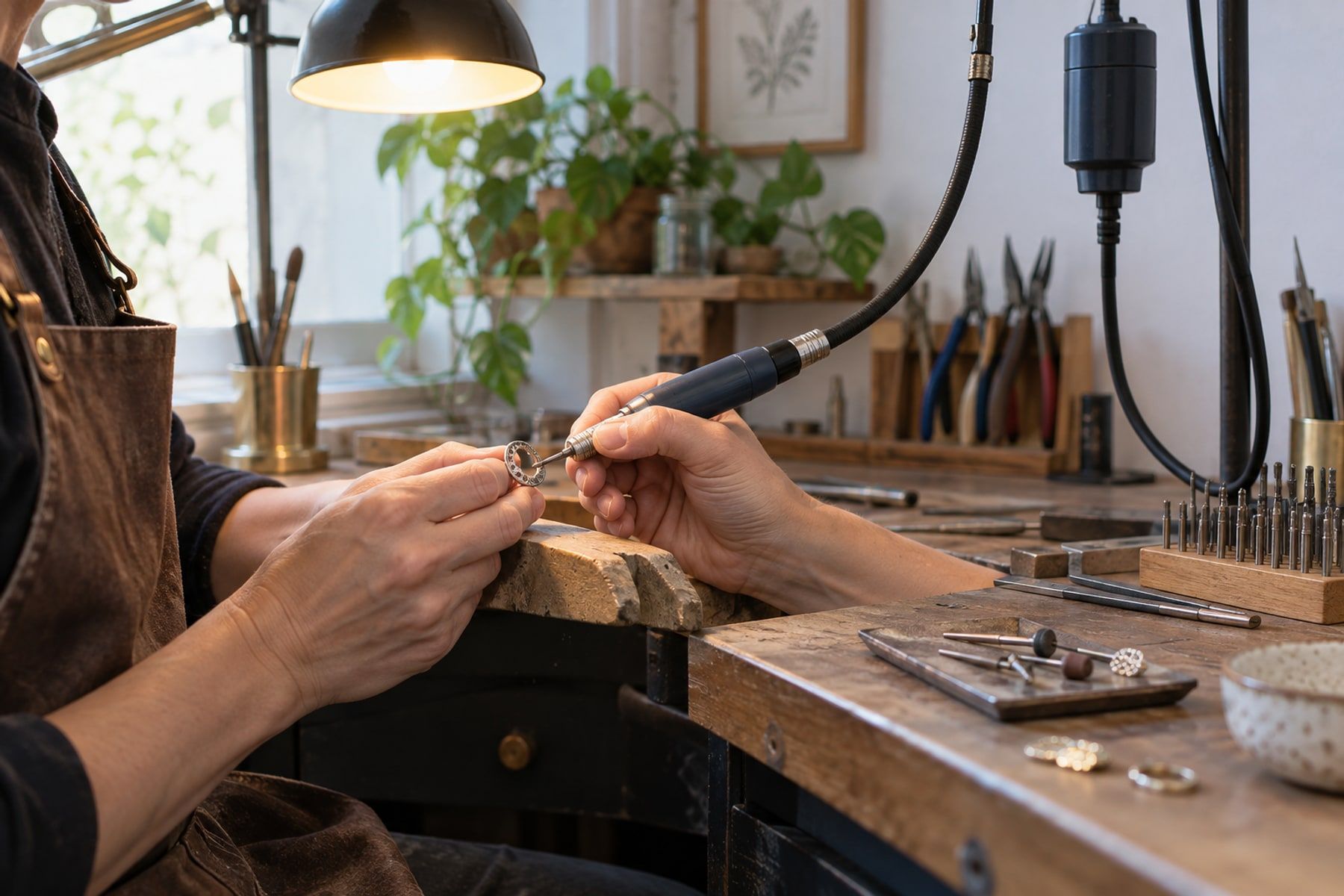
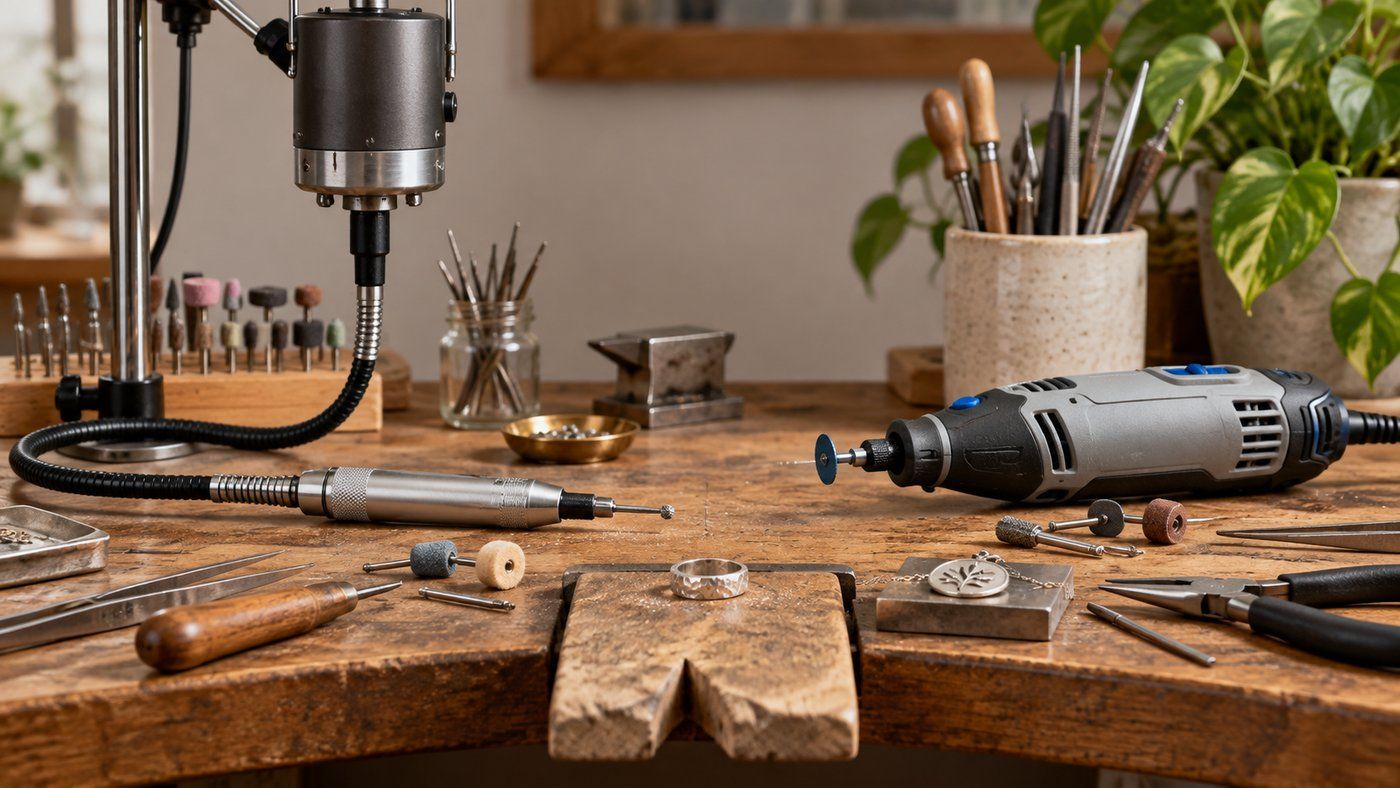
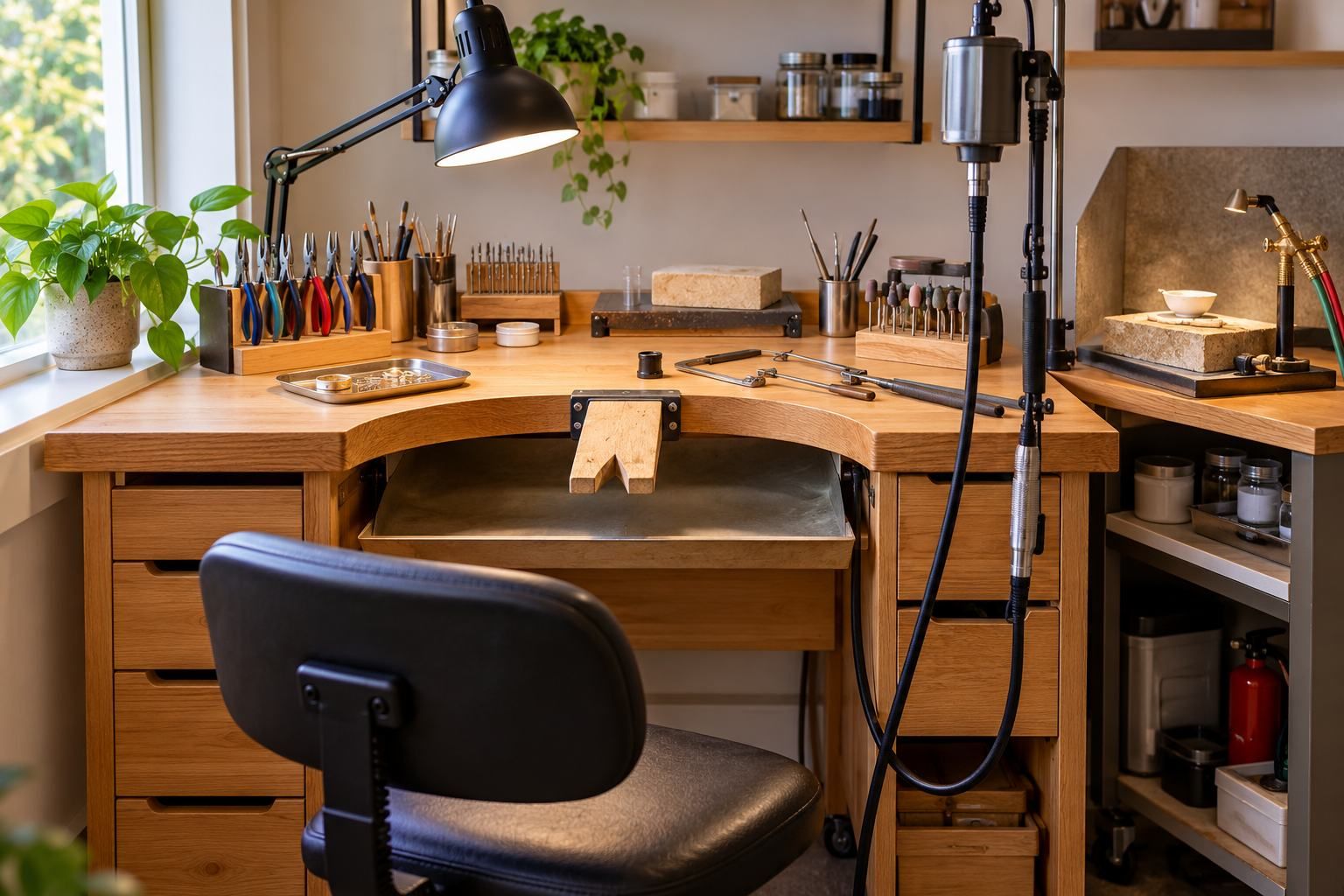
A flex shaft is the rotary workhorse on many jewelry benches. It drills, grinds, sands, polishes and drives specialist handpieces while keeping the motor’s weight off your hand. The best choice is not automatically the most powerful motor: it is the motor, control and handpiece combination that suits the work you do every week.
Quick answer
What is the best flex shaft for jewelry making?
The Foredom SR K.8301 is the best starting point for most home jewelers. Its reversible 1/6 hp motor, variable foot
control and versatile H.30 chuck handpiece cover routine bench work without locking you into one bur-shank size. The
Grobet C-300 is the stronger lower-cost specialist alternative. The SE 979FSG and VEVOR 780W are budget compromises for
occasional use, while the 1/3 hp Foredom TX is the upgrade for sustained heavy grinding.
The short version: match the flex shaft to the work
Your work
Start with
Trade-off to accept
General home jewelry work
Foredom SR with H.30 handpiece
Bur changes use a chuck key.
Lower-cost jewelry-focused setup
Grobet C-300
Less power and a shorter warranty than the SR.
Lowest-cost complete starter set
SE 979FSG
Package details and after-sales support are less consistent.
Budget grinding with a wide chuck range
VEVOR 780W
Bulkier handpiece and less established parts support.
Sustained heavy grinding or aggressive material removal
Foredom TX with a compatible handpiece
Forward-only, 115 V, and the verified motor/control listing needs a separate handpiece.
Decide these four things first
1. Motor: control and duty matter more than headline power
Foredom’s reversible SR motor is rated at 1/6 hp and up to 18,000 rpm. That is the sensible general-purpose specification for drilling, light grinding, sanding, polishing and setting work. Reverse is useful when the cutting direction or your working hand makes one rotation more controllable.
The TX is a different proposition: a 1/3 hp permanent-magnet motor with a 500–15,000 rpm range and stronger torque under load. It is the upgrade for sustained heavy cutting and grinding, not an automatic improvement for delicate jewelry work. It runs forward only and is sold only in 115 V versions.
Budget listings can claim higher wattage or maximum speed, but those numbers do not tell you how smoothly the pedal starts, how the motor behaves under load or whether replacement shafts and handpieces will still be available. Treat the entire system—not the biggest number—as the product.
2. Handpiece: versatility or faster bur changes
The handpiece often changes the daily experience more than the motor. Foredom’s H.30 uses a geared three-jaw chuck that accepts shanks from 0 to 5/32 inch (4 mm). That makes it the safer first handpiece when your burs, drills and mandrels use mixed shank sizes.
The H.20 quick-change handpiece swaps burs with a lever, but it accepts only 3/32-inch (2.35 mm) shanks. It is excellent for jewelers who already use that standard almost exclusively; it is a frustrating first choice if your kit includes 1/8-inch drills or other sizes. Both recommended motors use standard key-tip shafting, so compatible handpieces can be added later.
3. Speed control
A foot control lets you vary speed without taking a hand off the work. Pedal housing matters less than smooth response and correct motor compatibility. The SR’s FCT control and the TX’s TXR control look similar, but they are not interchangeable: Foredom specifies TXR, SXR or EMX controls for the permanent-magnet TX motor.
4. Bench space and hanging height
A hanging motor needs a secure support above the bench, enough cable reach for a neutral wrist position and a place to park the handpiece. Check the full working layout—not just the motor body—against your bench. The standard 39-inch shaft suits many seated setups, but a low or off-center hanger can make the cable pull at your hand.
Choose the K.8301 if you want a complete, adaptable first flex shaft. The verified configuration combines the reversible
SR motor, variable C.FCT foot control and H.30 chuck handpiece. It does not include a bur assortment, so plan a separate
accessory budget; the advantage is that you can select burs and mandrels for the work you actually make.
Best for: Most home jewelers buying a first professional hanging flex shaft.
Specs, strengths and limitations
Maximum speed
18,000 rpm
Motor power
1/6 hp, 125 W (115 V)
Forward / reverse
Yes
Speed control
Variable C.FCT foot control
Handpiece
H.30 three-jaw chuck, 0–5/32 in (4 mm)
Strengths
Complete motor, control and handpiece set
Reversible motor suits varied working directions
H.30 chuck accepts a wide range of bur and drill shanks
Standard key-tip shaft supports many interchangeable handpieces
Limitations
H.30 accessory changes require the supplied chuck key
No bur or abrasive assortment is included
Less torque than the TX for sustained heavy material removal
The C-300 is the middle ground between a premium Foredom system and a generic starter kit. Model 34.300 includes the
1/10 hp motor, variable foot control, shaft and No. 30-style handpiece with a 0–5/32-inch chuck. It gives up power,
reverse operation and one year of warranty coverage versus the SR, but it remains a jewelry-oriented, serviceable system.
Best for: Jewelers who want a complete specialist set below Foredom pricing and do not need the SR's reverse function or broader handpiece ecosystem.
Specs, strengths and limitations
Maximum speed
18,000 rpm
Motor power
1/10 hp, 110 V
Speed control
Variable foot control
Handpiece
No. 30-style three-jaw chuck, 0–5/32 in
Foot pedal
Included
Strengths
Complete motor, control, shaft and handpiece package
No. 30-style chuck accepts mixed bur and drill shank sizes
Ball-bearing motor is specified as lubrication-free
Jewelry-tool brand with replacement parts and handpieces available
Limitations
Lower 1/10 hp output than the Foredom SR
Forward/reverse operation is not documented for this configuration
The 979FSG is the value pick for occasional drilling, sanding and polishing. Its three-jaw chuck accepts shanks up to
5/32 inch, and the set includes a foot control, case and starter accessories. Buy it for the complete basic machine—not
for the accessory count, which varies across current and older seller descriptions.
Best for: Beginners who need a complete occasional-use kit at the lowest sensible entry price and accept less certain long-term parts support.
Specs, strengths and limitations
Maximum speed
22,000 rpm
Motor power
Listed as 1/4 hp, 110 V / 60 Hz
Speed control
Variable foot control
Handpiece
Three-jaw chuck, up to 5/32 in (4 mm)
Shaft length
42 in (retailer specification)
Strengths
Low-cost complete set with motor, control and handpiece
Three-jaw chuck accepts common jewelry-tool shank sizes
Carrying case and starter accessories are included
Replacement motor brushes are included in some documented packages
Limitations
Published accessory counts vary between versions and sellers
Warranty and replacement-parts support are not clearly documented
Included consumables should be treated as starter items
Less suitable for sustained daily studio use than serviceable specialist systems
This VEVOR is the budget choice when a wide 0.3–6.5 mm chuck and a claimed 500–23,000 rpm range matter more than a slim
jewelry handpiece. Its 780 W rating should not be compared directly with Foredom’s horsepower figures as proof of
superior real-world torque. The large chuck and less established parts network are the trade-offs.
Best for: Budget buyers who prioritize a wide chuck range and heavier grinding capacity over a jewelry-specialist handpiece system and long-term service network.
Specs, strengths and limitations
Maximum speed
23,000 rpm
Motor power
780 W, 110 V
Speed control
Stepless foot control, 500–23,000 rpm
Handpiece
Three-jaw chuck, 0.3–6.5 mm (about 1/4 in)
Shaft length
100 cm (about 39.4 in)
Strengths
Widest chuck capacity in this shortlist
Low 500 rpm starting specification and 23,000 rpm maximum
Complete set with foot control and starter accessories
Higher claimed output than the other budget kits
Limitations
Accessory count conflicts between the listing title and bullet copy
Claimed wattage is not directly comparable with Foredom horsepower ratings
Large handpiece is less suited to delicate close-grip work
Long-term parts and service support is less established than Foredom's
Choose the M.TX-TXR only when you regularly lean on larger abrasives or remove material heavily enough to benefit from
the 1/3 hp motor. The verified Amazon listing is not a complete ready-to-use set: it includes the TX motor, standard
key-tip shaft and TXR foot control, but you must add a compatible handpiece. For most home jewelers, the SR is better value.
Best for: Jewelers and small studios doing sustained heavy grinding or material removal who already know which handpiece they need.
Specs, strengths and limitations
Maximum speed
15,000 rpm
Motor power
1/3 hp, 250 W (115 V)
Forward / reverse
No
Speed control
Variable C.TXR foot control
Handpiece
Not included; accepts key-tip Foredom handpieces
Strengths
More torque under load than the SR motor
Permanent-magnet motor is designed for demanding cutting and grinding
Standard key-tip shaft accepts a broad handpiece range
The K.8304 combines the same reversible SR motor with Foredom’s H.20 lever-operated quick-change handpiece. It is a strong specialist choice when almost every bur you use has a 3/32-inch shank. We have kept it outside the monetized shortlist because we could verify the manufacturer configuration but not an exact active Amazon.com listing. The H.20’s speed comes with one hard limit: it does not accept 1/8-inch drills or other shank sizes.
Most home jewelers buying a first professional hanging flex shaft.
Jewelers who want a complete specialist set below Foredom pricing and do not need the SR's reverse function or broader handpiece ecosystem.
Beginners who need a complete occasional-use kit at the lowest sensible entry price and accept less certain long-term parts support.
Budget buyers who prioritize a wide chuck range and heavier grinding capacity over a jewelry-specialist handpiece system and long-term service network.
Jewelers and small studios doing sustained heavy grinding or material removal who already know which handpiece they need.
Maximum speed
18,000 rpm
18,000 rpm
22,000 rpm
23,000 rpm
15,000 rpm
Motor power
1/6 hp, 125 W (115 V)
1/10 hp, 110 V
Listed as 1/4 hp, 110 V / 60 Hz
780 W, 110 V
1/3 hp, 250 W (115 V)
Forward / reverse
Yes
Not verified
Not verified
Not verified
No
Speed controlFoot pedal, dial or electronic control.
Variable C.FCT foot control
Variable foot control
Variable foot control
Stepless foot control, 500–23,000 rpm
Variable C.TXR foot control
HandpieceIncluded handpiece type and collet/chuck capacity.
The Grobet C-300 costs less mainly by using a smaller motor while retaining a recognizable jewelry-tool system. The SE and VEVOR kits cut further into the entry price, but bring more uncertainty around package revisions, pedal response, shaft fit, replacement parts and documentation. A high wattage claim does not prove useful low-speed control or long-session durability.
If the budget option is the only one that fits, inspect it before committing your accessory system to it:
verify the voltage, rotation direction and maximum rated speed;
check whether the handpiece accepts the bur shanks you already own;
run the motor from low to high speed and listen for rubbing, surging or shaft slap;
confirm the inner shaft can be removed and lubricated;
find replacement brushes, shafts, sheaths and handpieces for the exact model; and
treat bundled abrasives as consumables, not the reason to choose the machine.
A well-supported used SR can be a better long-term buy than a new generic kit if the motor, control and shaft are in good condition.
Setup and ownership details that matter
Hang it securely
Use a purpose-made hanger or a rigid support with a safety clip. Set the motor high enough that the shaft forms a relaxed curve at your normal working position. Tight bends create heat and shorten shaft life.
Use light pressure
A flex shaft should let the abrasive or bur cut. Heavy pressure slows the accessory, increases heat and makes fine control worse. If a tool only works when forced, check its condition, grit, shape and speed before blaming the motor.
Maintain the inner shaft
Foredom’s TX service manual calls for checking, cleaning and lightly greasing the inner shaft at regular operating-hour intervals, with a more thorough solvent cleaning after extended use. Do not pack the sheath with grease: excess lubricant can migrate toward the handpiece. Follow the manual for your exact model rather than a generic maintenance schedule.
Protect yourself from dust and rotating tools
Wear eye protection, tie back hair, avoid loose sleeves and use suitable dust collection or respiratory protection for the material being worked. Secure tiny parts with a clamp, pin or holding tool when fingers would be too close to the accessory.
Common buying mistakes
Buying the strongest motor by default
The TX’s extra torque is valuable under sustained load, but it does not make routine drilling or polishing twice as precise. Most jewelers benefit more from the SR’s reverse function and a handpiece suited to their burs.
Treating a quick-change handpiece as universal
Quick-change is fast because it is size-specific. If you own mixed-shank accessories, start with the H.30 and add a quick-change handpiece later.
Missing a component in the listing
A complete flex-shaft machine needs a motor, matched speed control and handpiece. Hangers and accessories may still be separate. Read the component list, not the product photo alone.
Forgetting the bench layout
The motor can fit above the bench while the shaft still pulls sideways at the handpiece. Plan the hanger position, pedal location, cable path and handpiece rest together. Our home jewelry bench setup guide covers the wider layout.
Bottom line
For most home jewelers, buy the Foredom SR K.8301 and learn what your work actually demands before adding specialized handpieces or a stronger motor. Its H.30 handpiece accepts the broadest useful range of accessory shanks, the foot control keeps both hands free, and reverse adds practical flexibility.
Choose the Grobet C-300 when you want a lower-cost jewelry-focused system. The SE 979FSG is the sensible occasional-use starter, while the VEVOR 780W fits heavier budget grinding where its larger handpiece is acceptable. Move to the Foredom TX only when sustained material removal is a recurring part of your work. If you are still unsure whether a hanging motor earns its bench space, compare a flex shaft with a handheld rotary tool first.
Frequently asked questions
What is the best Foredom flex shaft for jewelry making?
The reversible 1/6 hp Foredom SR is the best default for most jewelers. It has enough power for routine drilling, grinding, sanding, polishing and setting work, and it accepts a wide range of key-tip handpieces. The 1/3 hp TX is better reserved for sustained, heavier cutting and grinding.
Is the Foredom SR powerful enough for jewelry?
Yes. Foredom rates the SR at 1/6 hp and up to 18,000 rpm, and describes it as the general-purpose choice for most users. Correct burs, light pressure and a well-maintained shaft matter as much as headline power for normal jewelry work.
Should a jeweler choose an H.30 or quick-change handpiece?
Choose the H.30 for a first handpiece because its three-jaw chuck accepts shanks from 0 to 5/32 inch. Add an H.20 quick-change handpiece if you use mostly 3/32-inch burs and change them frequently.
What is the difference between a flex shaft and a micromotor?
A flex shaft uses a hanging or bench motor that drives the handpiece through a flexible cable. A micromotor places a smaller motor in the handpiece, so there is no flexible drive cable. Micromotors feel compact, while flex shafts offer a broad handpiece system and strong general-purpose torque.
Do I need a foot pedal with a flex shaft?
A foot pedal is the practical choice for jewelry work because it lets you vary speed while keeping both hands on the work. Match the pedal to the motor series; the Foredom TX requires a TX-compatible control.
$Budget buyers who prioritize a wide chuck range and heavier grinding capacity over a jewelry-specialist handpiece system and long-term service network.
We have not personally used every product in this guide. Recommendations are based on specifications, manufacturer documentation, specialist references and owner experiences.
Specifications come from manufacturer documentation where it is available.
Specialist references, supplier catalogs and owner experiences are used to understand real-world strengths and weaknesses.
We do not claim physical testing, and we do not publish scores or star ratings.
Flex shaft vs Dremel for jewelry making: compare control, hand comfort, speed, drilling, polishing, stone setting and cost to decide which rotary tool fits your bench.
Set up a jewelry bench at home with the right bench height, bench pin position, lighting, seating, tool layout, metal recovery, soldering zone and safety.