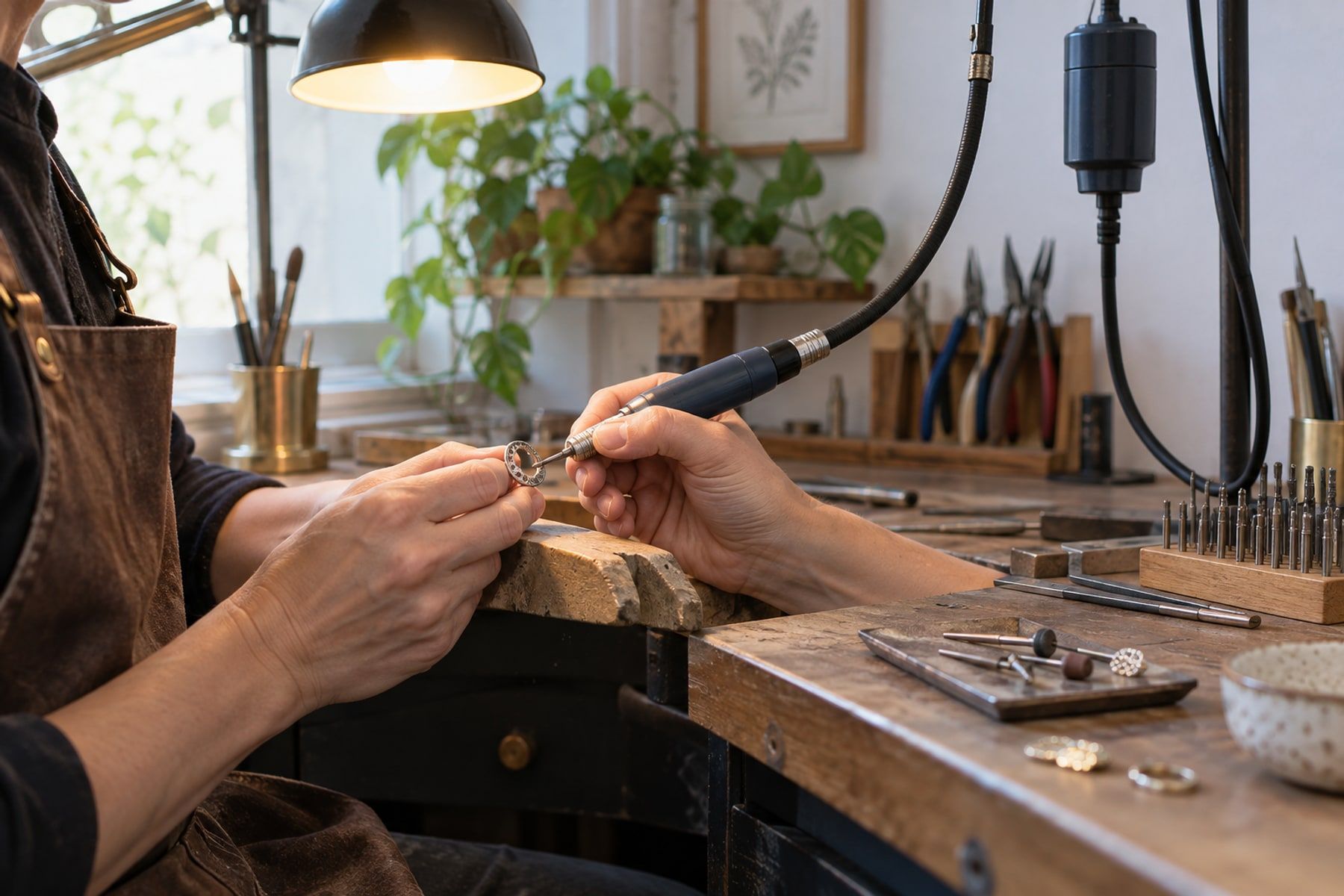
Buying guide · Rotary Tools
Best Flex Shafts for Jewelry Making
Compare five verified flex-shaft configurations for jewelry making, from budget starter kits to serviceable Foredom and Grobet bench systems.
Rotary ToolsComparison
Flex shaft vs Dremel for jewelry making: compare control, hand comfort, speed, drilling, polishing, stone setting and cost to decide which rotary tool fits your bench.
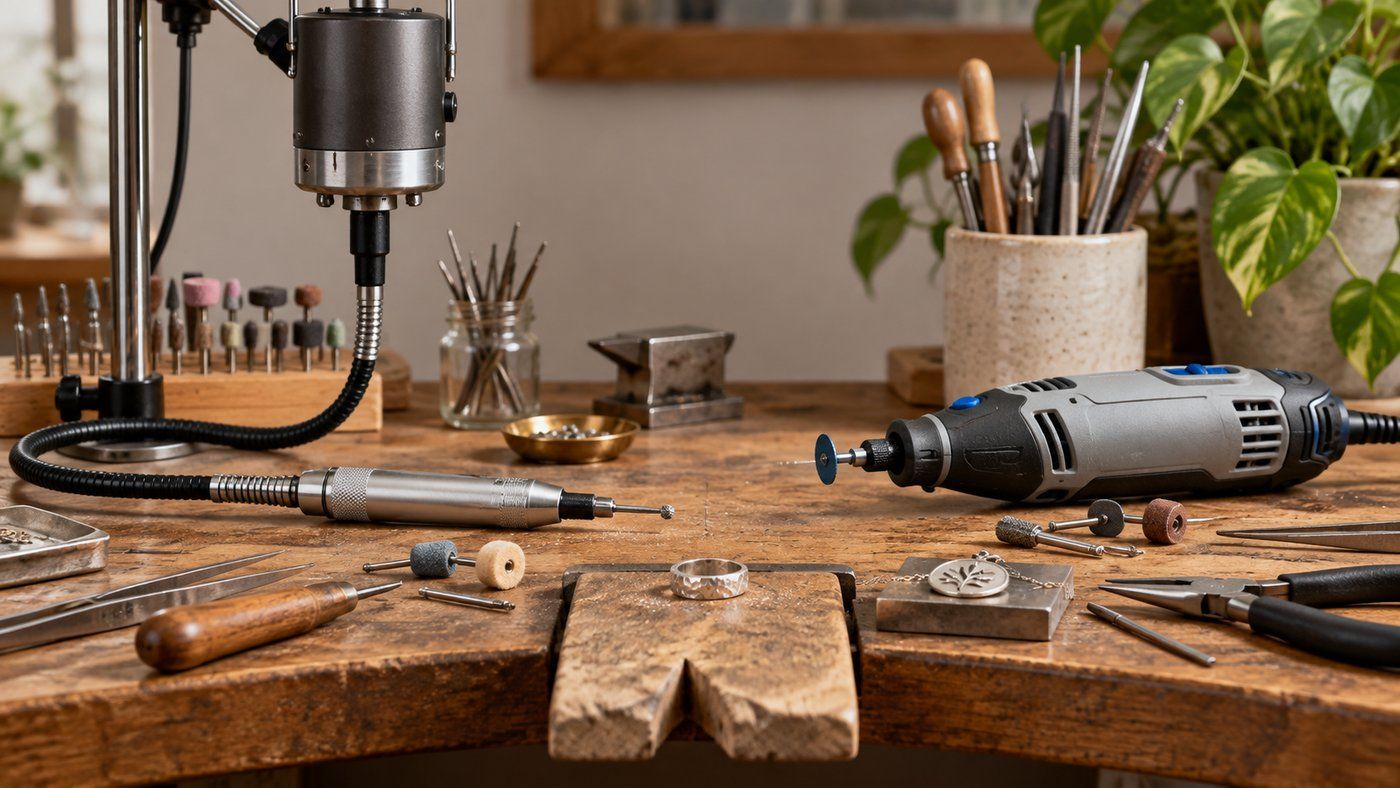
A flex shaft and a Dremel can perform many of the same jewelry-making jobs, but they are very different tools to work with at a bench.
A handheld rotary tool such as a Dremel keeps the motor, controls and spindle together in your hand. A traditional jewelry flex shaft puts the motor above or beside the bench and sends power through a flexible shaft to a much smaller handpiece.
That difference sounds minor until you spend an hour drilling, grinding, refining bezels or working through a series of burs.
The choice is therefore less about asking which tool can spin a bur and more about how frequently you use rotary tools, how precisely you need to control them and how comfortable you want your bench workflow to be.
Quick answer
Choose a flex shaft if rotary work is going to be a regular part of your jewelry making. The separate motor leaves a lighter handpiece in your hand, and jewelry-oriented systems commonly give you variable foot-pedal speed control and a choice of specialized handpieces.
Choose a Dremel-style rotary tool if you only need powered drilling, sanding, grinding or polishing occasionally, need something portable, or want to spend less while learning.
You do not need to buy both when starting. Many jewelers begin with a handheld rotary tool and move to a dedicated flex shaft when its limitations start interrupting their workflow.
| Consideration | Jewelry flex shaft | Dremel-style rotary tool |
|---|---|---|
| Motor location | Separate from the handpiece | Inside the tool in your hand |
| Handpiece feel | Smaller and generally easier to maneuver | Larger because you hold the motor as well |
| Speed control | Commonly variable foot control | Usually adjusted on the tool |
| Maximum speed | Depends on motor; Foredom SR reaches 18,000 RPM | Dremel 4300 reaches 35,000 RPM |
| Handpiece options | Wide choice including quick-change and chuck handpieces | One main tool spindle plus attachments |
| Frequent bur changes | Excellent with a quick-change handpiece | Easy with a keyless chuck, but less jewelry-specific |
| Long bench sessions | Better suited to repeated bench work | Usable, but you continue holding the motor |
| Portable work | Less convenient | Much easier to move or store |
| Bench space | Needs somewhere to hang or mount the motor | Very little permanent setup |
| Initial cost | Usually higher | Usually lower |
| Best suited to | Regular jewelry making and bench work | Occasional use and multi-purpose DIY work |
For a practical example, we are using the Foredom SR as the dedicated jewelry flex shaft and the Dremel 4300 as the handheld rotary tool.
| Foredom K.8301 SR flex shaft set on Amazon (opens in a new tab) | Dremel 4300 rotary tool on Amazon (opens in a new tab) | |
|---|---|---|
| Brand | Foredom | Dremel |
| Price tier | $$$ Upper mid-range | $$ Mid-range |
| Best for | Most home jewelers buying a first professional hanging flex shaft. | Occasional drilling, grinding and polishing where a hanging flex shaft is not yet justified. |
| Maximum speed | 18,000 rpm | Not verified |
| Motor power | 1/6 hp, 125 W (115 V) | Not verified |
| Forward / reverse | Yes | Not verified |
| Speed controlFoot pedal, dial or electronic control. | Variable C.FCT foot control | Not verified |
| HandpieceIncluded handpiece type and collet/chuck capacity. | H.30 three-jaw chuck, 0–5/32 in (4 mm) | Not verified |
| Shaft length | 39 in | Not verified |
| Foot pedal | C.FCT plastic-housing foot control | Not verified |
| Warranty | 2 years on motor and control | Not verified |
| Retailer | View on Amazon — Foredom K.8301 SR flex shaft set (opens in a new tab) | View on Amazon — Dremel 4300 rotary tool (opens in a new tab) |
These products should not be judged purely by their specification sheets because their architectures are different.
The Foredom SR is a 1/6 HP hanging flex-shaft motor rated to 18,000 RPM and available in forward/reverse configuration. Common jewelry kits pair it with a variable foot control and handpieces such as the H.30 chuck handpiece or H.20 quick-change handpiece.
The Dremel 4300 is a handheld 1.8-amp rotary tool with a variable range of 5,000–35,000 RPM and a keyless chuck.
That means the Dremel has the higher headline maximum RPM.
It does not automatically mean it is the better jewelry tool.
The Dremel 4300 reaches 35,000 RPM while the Foredom SR tops out at 18,000 RPM.
If you compared nothing except the number printed on the box, the Dremel could appear substantially more capable.
Jewelry work is not that simple.
Many operations involve controlling a small bur, abrasive, drill or polishing wheel against an equally small workpiece. You frequently need to start slowly, increase speed, back off again or stop completely without losing your position.
A higher maximum RPM may be useful for some accessories, but control at the speed you actually need is often more important than the highest possible speed.
Accessory manufacturers also specify suitable speed ranges for different cutters, abrasives and polishing tools. Faster is not automatically better, particularly when heat, delicate stones or small workpieces are involved.
This is the part that specification tables struggle to communicate.
With a conventional Dremel, you are holding the tool’s electric motor as well as the working end.
The Dremel 4300 weighs about 25 oz according to Dremel’s published specification. Its ergonomic body makes that manageable, especially for general-purpose work, but the complete rotary tool is still in your hand.
With a hanging flex shaft, the motor remains off the bench. Only the shaft and handpiece reach your working area.
That makes the tool at your fingertips feel more like a dedicated bench instrument than a small power tool.
For a five-minute polishing job, that distinction may barely matter.
If you spend a large part of a session changing burs, opening seats, refining metal, drilling or finishing castings, it becomes much more noticeable.
A traditional jewelry flex shaft normally pairs the motor with a variable foot-operated speed control.
Press farther and the motor accelerates. Ease off and it slows.
Your hands remain where they are.
That is particularly useful during work where the tool repeatedly enters and leaves the metal. You can approach the work slowly, increase speed while cutting, then release the pedal without taking a hand away to find a dial.
The Dremel 4300 also has variable speed, but its speed setting is on the rotary tool itself.
That works perfectly well for jobs where you select a suitable speed and leave it there.
The difference appears when you want to change speed repeatedly during the operation.
Consider using a small bur around a setting.
You may want to:
A foot-controlled flex shaft makes that sequence particularly natural.
It is one reason dedicated flex shafts remain common on jewelry benches even though inexpensive handheld rotary tools can perform many of the same basic operations.
There is considerable overlap.
Both can potentially be used for:
The difference is therefore not usually “Can a Dremel do this?”
It often can.
A more useful question is:
“How often am I going to do this, and how much control do I want while doing it?”
Both tools can drill jewelry-sized holes when fitted with an appropriate chuck or collet and drill bit.
For occasional drilling, a Dremel can be entirely adequate.
A flex shaft becomes more attractive when drilling is one stage of a longer bench process because the small handpiece and foot control integrate more naturally into repeated work.
For very precise drilling, remember that neither automatically substitutes for good technique or a drill press. Small drill bits wander and break easily.
Use a center mark where appropriate, support the work securely and let the drill cut rather than forcing it through the metal.
This is another area where both tools are capable.
Mounted abrasive points, sanding drums, rubber abrasives and suitable burs can remove material or refine an edge.
A Dremel works particularly well when the job is occasional and you already own the tool.
A flex shaft starts to earn its place when you move repeatedly between different abrasives and cutters during fabrication.
The benefit becomes even more obvious if you add a jewelry-oriented quick-change handpiece.
For someone moving into stone setting, a dedicated flex shaft becomes much easier to justify.
Stone-setting work often involves relatively small cutters and repeated, controlled adjustments.
The ability to hold a compact handpiece while varying motor speed with your foot is well suited to this type of work.
Foredom’s H.20, for example, is a quick-change handpiece designed around 3/32-inch shank accessories, a very common format for jewelry burs.
Instead of opening and tightening a chuck every time you swap cutters, you can change compatible burs much more quickly.
A general-purpose Dremel can still operate small cutters, but the dedicated jewelry ecosystem starts to matter when bur changes happen continually rather than a few times per project.
Both tools can handle small-scale polishing.
You can use suitable buffs, brushes, radial discs and polishing accessories to reach places that would be awkward on a larger polishing machine.
For occasional finishing or cleaning, a Dremel is convenient.
For repeated bench finishing, a flex shaft’s handpiece and speed control can be more comfortable.
Whichever tool you use, polishing deserves caution.
Small wheels can:
Wear appropriate eye protection, secure the work when necessary and do not assume higher speed means a better finish.
It would be misleading to describe a Dremel as merely a beginner’s compromise.
A good handheld rotary tool has some genuine advantages.
If you are building your first jewelry bench, you may also need saws, files, pliers, measuring tools, a torch setup, lighting and many other basics.
Putting several hundred dollars into a dedicated flex-shaft system immediately may not be the best use of your budget.
A Dremel can cover numerous powered tasks while you discover which types of jewelry making you actually enjoy.
A hanging flex shaft works best when it has a permanent home.
A handheld rotary tool goes into a case or drawer and can move between benches easily.
That matters if you work at a dining table, share your workspace or do not yet have a permanent jewelry bench.
A Dremel is fundamentally a general-purpose rotary tool.
The same machine can be useful for household repairs, crafts and other workshop jobs.
If jewelry making is only one of several hobbies, that versatility may be more valuable than owning a more specialized system.
You probably do not need to upgrade because somebody tells you that “real jewelers use a flex shaft.”
Upgrade when your existing tool creates a practical problem.
Common signs include:
At that stage, the flex shaft is solving actual workflow problems rather than merely adding another tool.
This is an important middle ground.
Dremel sells the 225 Flex Shaft Attachment, which is compatible with the 4300 and several other Dremel rotary tools.
Instead of holding the full rotary tool, you hold a much smaller handpiece connected through a flexible cable.
Dremel specifies a cable length of approximately 36 inches.
That addresses one of the biggest disadvantages of a handheld rotary tool: the size and weight in your hand.
If you already own a compatible Dremel, the attachment can be a sensible way to make detailed work more comfortable without immediately buying an entirely new motor system.
Not quite.
A Dremel with its flex-shaft attachment and a dedicated jewelry flex shaft now look more similar at the working end, but the systems still differ.
The Foredom ecosystem is built around the flexible shaft itself, with dedicated motors, foot-operated variable controls and interchangeable handpieces intended for different bench tasks.
The Dremel attachment is an accessory driven by your existing rotary tool.
So the Dremel flex shaft can narrow the ergonomic gap considerably, but it does not automatically give you the same bench workflow, handpiece ecosystem or foot-controlled variable speed as a conventional jewelry flex shaft.
Buying a flex shaft introduces another decision that Dremel owners may not initially expect: which handpiece?
Two common Foredom options illustrate the trade-off.
The H.30 is a versatile general-purpose choice.
It uses a three-jaw geared chuck and accepts accessories across a useful range of shank diameters.
That makes it suitable if you expect to switch between different types and sizes of accessories.
For a first flex-shaft setup, versatility is its major advantage.
The H.20 is more specialized.
It accepts 3/32-inch shank accessories and is designed to make compatible bur changes fast.
That makes it attractive to jewelers and setters who repeatedly switch between burs of the same shank size.
The trade-off is reduced universality.
This illustrates one of the broader differences between a Dremel and a dedicated flex shaft: a flex-shaft motor can become the center of a modular bench system rather than remaining a single rotary tool.
If you are starting jewelry making from zero, you do not need a flex shaft simply because professional benches have them.
Your first priority should be having the tools required for the techniques you are actually learning.
If your early projects mainly involve:
a rotary tool may not even be the most important purchase.
When you start drilling, grinding, using burs, cleaning castings or polishing regularly, powered rotary equipment becomes more useful.
For a beginner who wants powered capability without committing heavily, a Dremel is a reasonable starting point.
For someone already confident that jewelry making will become a serious long-term hobby or business, buying a good flex shaft from the beginning can avoid paying twice.
Space changes the calculation.
A Dremel is easier to store.
Finish your work, unplug it and place it in a drawer or case.
A traditional hanging flex shaft usually needs:
None of these requirements is large in a dedicated workshop, but they matter when your “studio” is a corner of a bedroom or a shared table.
If you do choose a flex shaft, think about its position before mounting the hanger. The shaft should reach your working area comfortably without forcing you to fight its bend while using the handpiece.
See our jewelry bench setup guide for the rest of the layout.
For a permanent jewelry bench, it may replace most of the work you previously performed with a Dremel.
But the tools are not perfectly interchangeable.
A Dremel remains easier to pick up and take elsewhere, and its broader DIY attachment ecosystem may be useful for non-jewelry jobs.
Some jewelers therefore end up owning both:
That does not mean you need both from day one.
For occasional jewelry making, quite possibly.
If you make a few pieces each month and only occasionally drill, grind or polish, there may be little reason to invest in another powered system.
The distinction becomes more significant as your rotary-tool usage increases.
A dedicated flex shaft should be thought of less as a way to unlock tasks that are impossible with a Dremel and more as a better interface for repetitive jewelry bench work.
That is why people often upgrade only after using a handheld tool for some time.
| Your situation | Better fit | Why |
|---|---|---|
| New to jewelry making | Dremel or no powered tool yet | Lower commitment while you learn which techniques you use |
| Occasional hobby projects | Dremel | Affordable, portable and capable of common rotary jobs |
| Regular jewelry maker | Flex shaft | Better workflow for frequent bench use |
| Stone setting | Flex shaft | Foot speed control and jewelry handpieces are particularly useful |
| Frequent bur changes | Flex shaft with quick-change handpiece | Designed for repetitive bur-based work |
| Shared or temporary workspace | Dremel | Easier to pack away after each session |
| Permanent jewelry bench | Flex shaft | The hanging setup is much less inconvenient once permanently installed |
| Already own a Dremel | Keep using it until it limits you | You may not need another tool yet |
| Dremel feels too bulky | Try the Dremel flex shaft or upgrade | Both move the main motor weight away from your hand |
| Want one rotary tool for many hobbies | Dremel | General-purpose portability and accessory ecosystem |
For occasional jewelry making, a Dremel is enough for far more jobs than it sometimes gets credit for.
You can drill, grind, sand, polish and use many small rotary accessories without installing a dedicated system at your bench.
For regular jewelry making, however, we would choose a proper flex shaft.
The reason is not its maximum speed.
It is the combination of a small handpiece, motor positioned away from your hand, foot-controlled variable speed and access to jewelry-specific handpieces.
Those advantages become more valuable every time you reach for the tool.
If you already own a Dremel, there is no urgency to replace it. Use it until you can identify a limitation that actually affects your work.
When you find yourself using it throughout most bench sessions — particularly for bur work or stone setting — that is when a flex shaft becomes a much easier purchase to justify.
Ready to compare dedicated systems? See our best flex shafts for jewelry making.
For frequent bench work, usually yes. A jewelry flex shaft separates the motor from the handpiece and commonly uses a foot pedal for variable speed, giving you a lighter tool in your hand and easier speed changes while you work. A Dremel remains a practical and less expensive choice for occasional drilling, grinding, sanding and polishing.
Yes. A Dremel can drill, grind, sand, polish, engrave and perform many other jewelry-making tasks when fitted with suitable accessories. Its main disadvantage for prolonged bench work is that the motor remains in the tool you are holding and speed is normally adjusted on the tool rather than continuously with your foot.
No. Beginners can start with hand tools or a Dremel-style rotary tool. A flex shaft becomes more valuable when rotary work is part of most bench sessions, especially when you regularly use burs, drill small holes, refine castings, polish details or perform stone-setting work.
A Dremel flex shaft attachment moves the working handpiece away from the rotary tool motor, making the part in your hand smaller and lighter. A dedicated jewelry flex shaft such as a Foredom uses a separate hanging motor, interchangeable handpieces and typically a variable foot-operated speed control, making the whole system better suited to repeated bench work.
Power cannot be compared reliably from maximum RPM alone. The Foredom SR is designed as a dedicated flexible-shaft system for sustained bench work and runs up to 18,000 RPM, while the Dremel 4300 runs from 5,000 to 35,000 RPM. For jewelry work, control, torque under load, handpiece design and speed control can matter more than maximum RPM.
Yes. Small polishing wheels, brushes and suitable compounds can be used with a Dremel for localized jewelry polishing. Use appropriate speeds and light pressure because small components can heat rapidly and polishing accessories can grab edges or loose workpieces.
It can be if you make jewelry regularly. The biggest benefit is not simply more power but a lighter handpiece, foot-controlled speed and access to jewelry-oriented handpieces. Occasional hobbyists may be perfectly well served by a handheld rotary tool.
That is a sensible route for many beginners. A Dremel shows you how often you actually use powered rotary tools, and if its size, speed controls or workflow later get in your way, you will understand exactly why you are paying more for a dedicated flex shaft.
Foredom
$$$Most home jewelers buying a first professional hanging flex shaft.
Dremel
$$Occasional drilling, grinding and polishing where a hanging flex shaft is not yet justified.
We have not personally used every product in this guide. Recommendations are based on specifications, manufacturer documentation, specialist references and owner experiences.
Full details: how we review and research tools and oureditorial policy.
Buying guide · Rotary Tools
Compare five verified flex-shaft configurations for jewelry making, from budget starter kits to serviceable Foredom and Grobet bench systems.
How-to · Bench
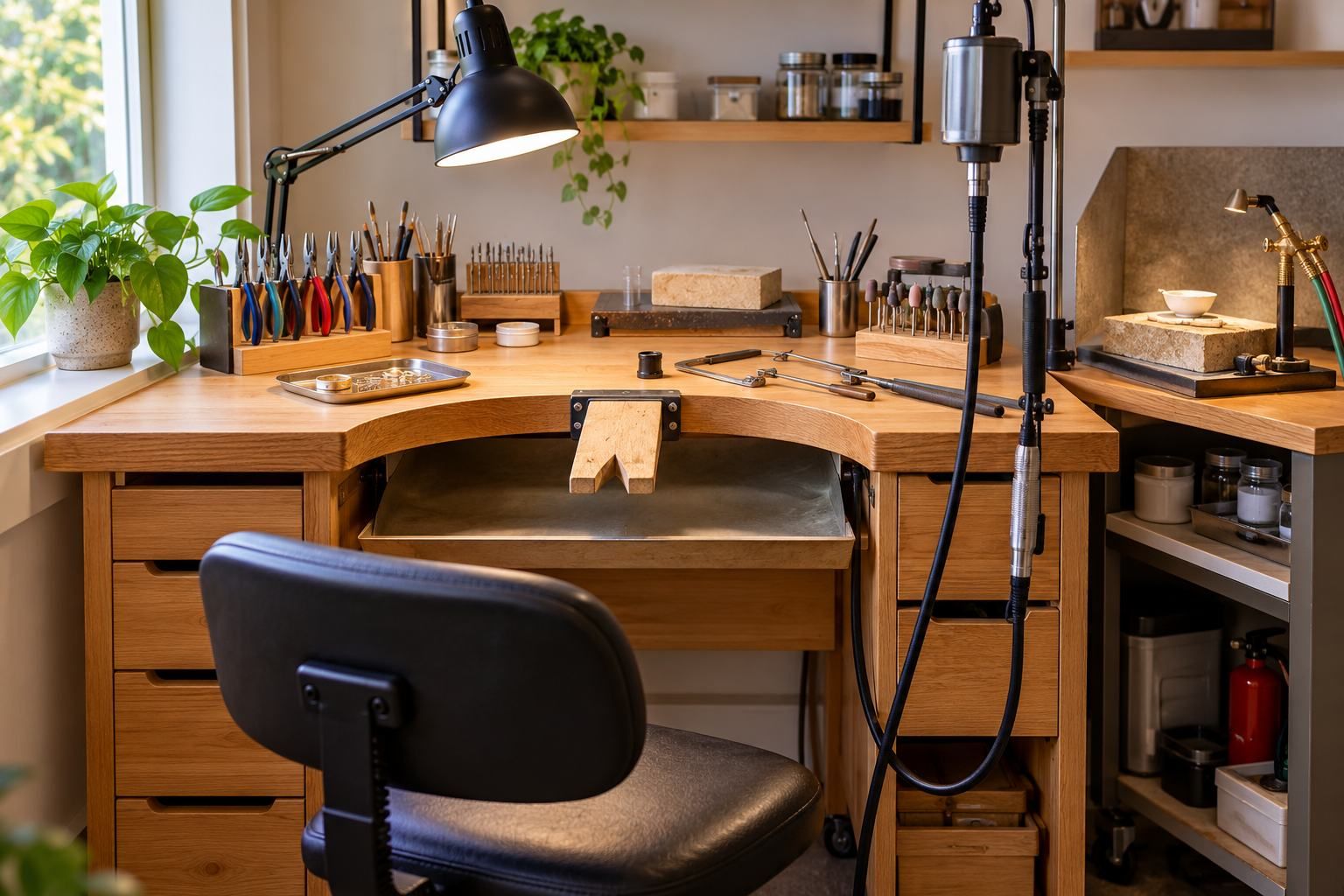
Set up a jewelry bench at home with the right bench height, bench pin position, lighting, seating, tool layout, metal recovery, soldering zone and safety.