Explainer · Rolling & Forming
What Size Rolling Mill Do I Need for Jewelry Making?
How to choose rolling mill size for jewelry making — usable flat width vs roller width, 80 vs 110 vs 130 mm mills, cuffs, texture plates and bench space.
Rolling & FormingComparison
Combination vs flat rolling mills compared for jewelry making — including usable sheet width, wire grooves, versatility and which type is better for your bench.
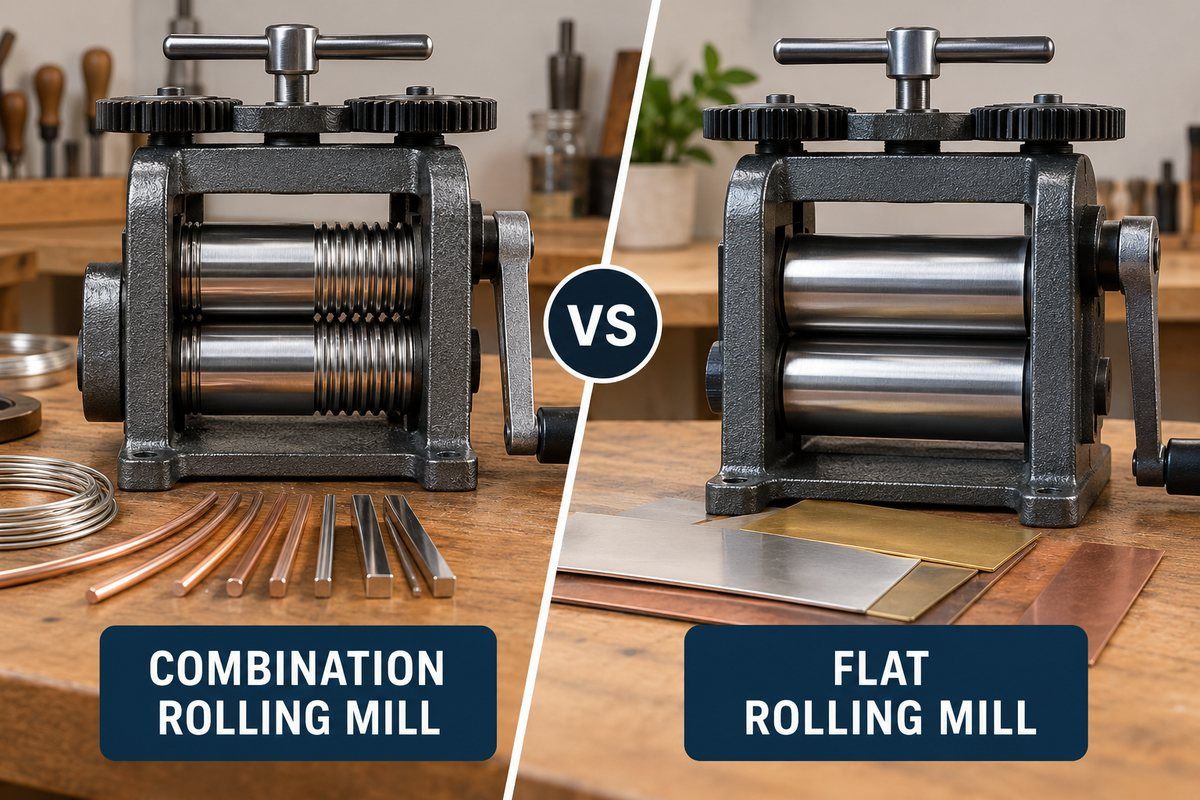
A combination rolling mill and a flat rolling mill can both reduce and form metal, but they allocate their rollers differently.
A combination mill divides the main rollers between a smooth flat section and a series of grooves for reducing wire. A flat mill dedicates essentially the entire working width of its main rollers to smooth sheet and strip.
That difference sounds small, but it affects one of the most important specifications when choosing a mill: how much usable flat rolling width you actually get.
Quick answer
Choose a combination rolling mill if this will be your only mill and you expect to work with both sheet and wire. It gives a home jewelry bench more forming options from one machine.
Choose a flat rolling mill if most of your work involves sheet, strip, texture plates or wider pieces and you want the maximum possible smooth rolling width.
Do not compare the mills using total roller width alone. On a combination mill, part of that width is occupied by wire grooves. Compare the usable flat area instead.
| Consideration | Combination mill | Flat mill |
|---|---|---|
| Rolling sheet | Yes | Yes |
| Usable sheet width | Less than total roller width | Usually close to full roller width |
| Reducing square wire | Yes, with suitable grooves | No dedicated grooves |
| Flattening wire | Yes | Yes |
| One-machine versatility | Higher | Lower |
| Best for wider sheet | Less suitable at the same roll width | Better |
| Best as a first mill | Usually | If your work is mainly sheet |
| Best as a second specialist mill | Sometimes | Often |
The important distinction is not that one mill can roll sheet and the other cannot. Both can roll sheet.
The real choice is whether you want to sacrifice part of your flat rolling surface in exchange for built-in wire-forming capability.
A combination rolling mill places smooth flat rollers and wire grooves on the same pair of rolls.
The flat portion works much like a normal flat mill. You can use it to reduce sheet thickness, roll strip, prepare metal for fabrication and perform other operations that require smooth rollers.
The grooved section is designed for wire or bar. A typical jewelry combination mill has a progression of grooves that become smaller across the roller. Metal can be passed through progressively smaller grooves to reduce its cross-section.
This makes a combination mill attractive when bench space or budget allows for only one rolling mill.
Instead of buying one mill for sheet and another for wire, you get both functions in one machine.
This is worth checking carefully when shopping.
Many combination mills use square-wire grooves on their main rollers. Depending on the model, additional extension rollers may provide half-round, D-shaped or other profiles.
Some mills offer interchangeable rollers with additional patterns or profiles.
Others do not.
So don’t assume that a mill described as “combination” automatically makes:
Look at the actual groove specifications.
If you specifically want to make ring shanks, half-round stock or another profile, confirm that the required groove is included or available as an accessory.
A flat rolling mill uses smooth rollers across essentially the full working width of the machine.
Its job is simpler: provide as much uninterrupted rolling surface as possible for sheet, strip and other flat stock.
You give up the built-in wire grooves of a combination mill, but in return you get more usable flat width from a similarly sized roller.
That can be a significant advantage if sheet work makes up most of what you do.
For example, a jeweler making:
may value an extra few centimetres of uninterrupted roller much more than a set of wire grooves.
This is the specification I would pay closest attention to when comparing combination and flat mills.
A manufacturer may advertise a mill as having 100 mm rollers, but that does not necessarily mean you can pass a 100 mm-wide piece of sheet through the smooth section.
On a combination mill, the roller might be divided roughly like this:
flat area | wire grooves
Only the flat portion is available for normal sheet rolling.
A useful real-world example is Durston’s DRM C100 combination mill. Its total roll width is 100 mm, but 65 mm is allocated to the flat rolling area, with the remaining width used for wire grooves.
By comparison, Durston’s DRM F100 flat mill provides 100 mm of flat rolling width.
So two machines can both have “100 mm rolls” while offering substantially different sheet capacity.
This is why I would not buy a combination mill based only on the number in its model name.
Quick answer
For a combination mill, look for the specification called flat area, flat width, flat rolling area or similar.
That is the number that tells you how wide a piece of sheet can actually fit between the smooth section of the rollers.
Compare that number with the full flat width of a dedicated flat mill.
If you are also deciding between 80 mm, 100 mm, 130 mm and larger machines, see our guide to choosing rolling mill size.
The main additional capability is controlled wire reduction using grooves.
Suppose you start with a square bar or thick square wire.
On a combination mill, you can progressively move it through smaller square grooves, typically rotating the work as appropriate between passes to maintain an even section.
That gives you a controlled way to reduce the material while maintaining a broadly square profile.
You may then continue forming the material using a drawplate or other tools depending on the final wire profile and dimensions you need.
This can be particularly useful if you:
A dedicated flat mill cannot replicate those grooves using its main smooth rollers.
Yes — but this is where terminology can become confusing.
You can absolutely put wire between flat rollers.
What matters is what you want to happen to the wire.
If you pass round wire through flat rollers, the rollers compress it and change its profile. That can be useful when intentionally making flat strip or modifying wire for a design.
What the flat mill cannot do is act like a set of square-wire grooves and reduce the wire while maintaining that intended grooved profile.
So the useful distinction is:
Want to flatten wire?
Flat rollers can do it.
Want to reduce wire using progressively sized square or shaped grooves?
You need suitable grooved rollers.
That could mean a combination mill, a dedicated wire mill or another compatible roller setup.
It does not inherently roll sheet badly.
The compromise is primarily width, not the basic ability to reduce sheet.
Within its smooth section, a well-made combination mill can still be a capable sheet-rolling machine.
The problem appears when your work becomes wider than that flat section.
Imagine comparing two 100 mm mills:
If the pieces you normally roll are 30–40 mm wide, both may give you all the width you need.
If you regularly need 70–80 mm of smooth rolling surface, that difference becomes much more important.
This is why the “best” configuration depends more on the type and dimensions of your work than on the mill category itself.
A combination mill is particularly attractive for a small or general-purpose jewelry workshop.
When you do not yet know exactly where your jewelry making will take you, versatility has value.
A combination mill lets you explore both sheet and wire work without immediately committing bench space and money to two machines.
Rolling mills are heavy tools that need a stable mounting position.
If your workshop has room for only one, fitting sheet and wire capability into the same machine can be more practical than adding a second specialist mill later.
If one project starts with sheet and the next requires reducing square wire, you can perform both operations without changing machines.
Jewelers who cast ingots or reuse scrap may value wire grooves more than someone who buys all sheet and wire in finished dimensions.
The ability to turn rough stock into progressively smaller bar or wire makes the combination format more useful.
The width penalty matters only if you actually need the missing width.
If your combination mill provides 65–75 mm of flat area and nearly everything you make fits comfortably inside it, sacrificing the rest of the roller may have little practical impact.
A flat mill becomes more compelling when sheet is the priority rather than one of several jobs.
This is the clearest reason to choose flat rollers.
At the same total roll width, a dedicated flat mill generally gives you more uninterrupted usable space.
If you normally purchase wire in the size and profile you need, built-in square-wire grooves may sit unused.
In that case, giving up flat width for a feature you rarely use makes less sense.
A wide uninterrupted smooth area can be useful when rolling textured sheet or working with pattern materials.
The required width still depends on your pieces, but sheet-heavy work generally benefits from more flat surface.
A studio with a separate wire mill, drawbench or other wire-forming setup has less reason to duplicate those functions on its sheet mill.
In professional workshops, separate specialist machines can be more practical than asking one mill to perform every job.
There is another trap when comparing specifications.
You might reason that if a 100 mm combination mill has too little flat area, buying a 130 mm combination mill solves the problem.
Sometimes it does — but check the numbers.
The additional width may be divided between both the flat area and additional wire grooves.
For example, a current Durston 130 mm combination configuration lists 75 mm of flat rolling area rather than making all 130 mm available for sheet.
So again, ignore the headline roller width for a moment and ask:
What is the actual width of the smooth section?
That measurement has much more practical value.
Interchangeable rollers can make the combination-versus-flat decision less permanent, but the feature varies considerably between mills.
Depending on the design, manufacturers may offer:
However, not every rolling mill lets you replace its main rollers conveniently — and rollers from one series should not be assumed to fit another.
If interchangeability is important to you, check before purchasing:
Buying a mill because you assume “I’ll just add different rollers later” can otherwise be an expensive mistake.
There is a third option: don’t combine the functions at all.
A workshop with enough budget and space can use:
This avoids the central compromise of a combination mill.
Some professional machines even place separate flat and grooved roller sets in the same larger assembly.
For most home jewelry benches, however, two full machines are harder to justify when starting out.
A good combination mill is often the more practical way to gain both capabilities first. A specialist flat or wire mill can be added later if your work develops in that direction.
Roller configuration is important, but it should not be the only specification you compare.
For combination mills, find the actual width of the smooth section.
Do not substitute total roller width.
If you’re choosing combination rollers because you want wire capability, check exactly what grooves you are paying for.
Make sure their size range overlaps the work you expect to make.
Square, round, half-round and D-shaped grooves are different things.
Look at the manufacturer’s diagram or specifications instead of relying on the word “combination.”
Check how thick a piece of metal the mill is designed to accept.
This can matter if you intend to start from thicker ingots rather than commercially prepared sheet.
A geared rolling mill multiplies the force applied through the handle, making substantial reductions easier than on a comparable direct-drive mill.
Our rolling mill gear ratio guide explains what ratios such as 3:1, 4:1 and 5:1 mean.
Roller dimensions, hardness, frame rigidity, bearings and machining quality all influence the mill.
A wider roller configuration alone does not make one mill better than another.
Check what is available now rather than assuming accessories will exist later.
A rolling mill should be securely mounted to a sufficiently strong bench or stand.
Larger mills can be very heavy, so dimensions and weight deserve almost as much attention as roller specifications.
For a bench with room for only one rolling mill, I would normally start by looking at combination models.
Not because combination rollers are inherently better, but because the unused capability penalty is relatively small if the flat section is already wide enough for your work.
You gain wire grooves while retaining the ability to roll sheet.
The exception is someone who can already say:
“Almost everything I want this mill for involves sheet.”
In that situation, a flat mill deserves serious consideration.
There is little benefit in sacrificing a large part of your roller to wire grooves if you rarely expect to use them.
Instead of asking “Which rolling mill type is better?”, ask yourself these three questions.
Measure it.
If it is wider than the flat area on the combination mill you’re considering, the decision may already be made.
If yes, combination rollers become much more valuable.
If you intend to buy finished wire and mainly roll sheet, those grooves may offer little benefit.
If yes, versatility matters more.
If you already expect to build a larger workshop with specialist machines, a full-width flat mill may fit the longer-term setup better.
Quick answer
For most beginners buying a single mill, I would compare combination rolling mills first, because they cover both sheet and grooved wire work.
But check the usable flat width before buying. If the combination mill’s flat section is narrower than the sheet you expect to make, choose a wider combination mill or a dedicated flat mill instead.
For most small jewelry benches, a combination rolling mill is the more versatile first purchase.
It handles the sheet-rolling jobs most beginners need while adding grooves for reducing wire, and it avoids immediately needing two machines.
But versatility is not free.
The wire grooves take space away from the smooth rollers. If sheet is the reason you are buying the mill, a dedicated flat model may give you significantly more useful working area for the same nominal roll width.
So don’t make the decision from “100 mm”, “130 mm” or another headline measurement alone.
Compare:
usable flat width + groove profiles + gear ratio + maximum opening + the work you actually make.
That will tell you far more than whether the mill is simply labelled combination or flat.
If you’re still deciding what size you need, read What Size Rolling Mill Do You Need?. If you’re ready to compare individual models, continue to our best rolling mills for jewelry making.
A combination rolling mill is usually the more versatile first mill because it can roll sheet on its flat section and reduce wire in its grooves. A flat mill is a better fit when you mainly work with sheet and want the maximum usable flat width.
You can pass wire through flat rollers to flatten it or reduce its thickness, but flat rollers will change the wire's cross-section. To progressively reduce square wire while retaining a controlled profile, you need suitable wire grooves or a separate wire mill.
The main trade-off is usable sheet width. Wire grooves occupy part of the roller, so a combination mill can have substantially less flat rolling area than its stated total roller width.
Yes. A combination mill has a smooth flat section specifically for rolling sheet and strip. The limitation is that this section is narrower than the mill's total roller width because part of the roller is allocated to wire grooves.
No. Groove profiles vary by model. Many combination mills include square-wire grooves, while half-round, D-shaped, round or other profiles may require side extensions, interchangeable rollers or a different mill.
It depends on the mill. Some models support interchangeable or extension rollers, while others have fixed main rollers. Check the manufacturer's roller options before buying if you expect your work to change.
We have not personally used every product in this guide. Recommendations are based on specifications, manufacturer documentation, specialist references and owner experiences.
Full details: how we review and research tools and oureditorial policy.
Explainer · Rolling & Forming
How to choose rolling mill size for jewelry making — usable flat width vs roller width, 80 vs 110 vs 130 mm mills, cuffs, texture plates and bench space.
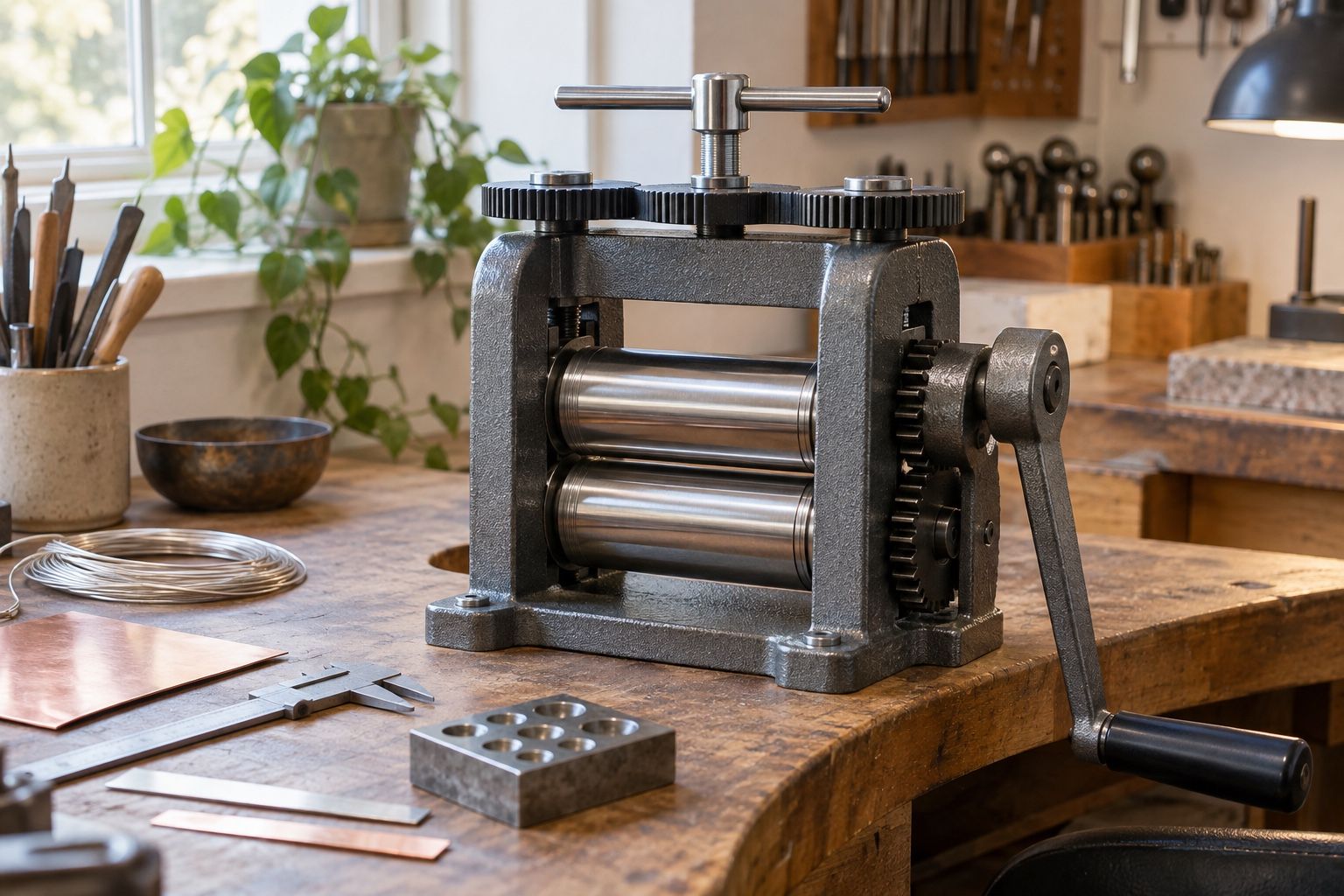
Buying guide · Rolling & Forming
Choose the right jewelry rolling mill by roller width, configuration, gearing and bench space, with a research-based look at budget and professional options.
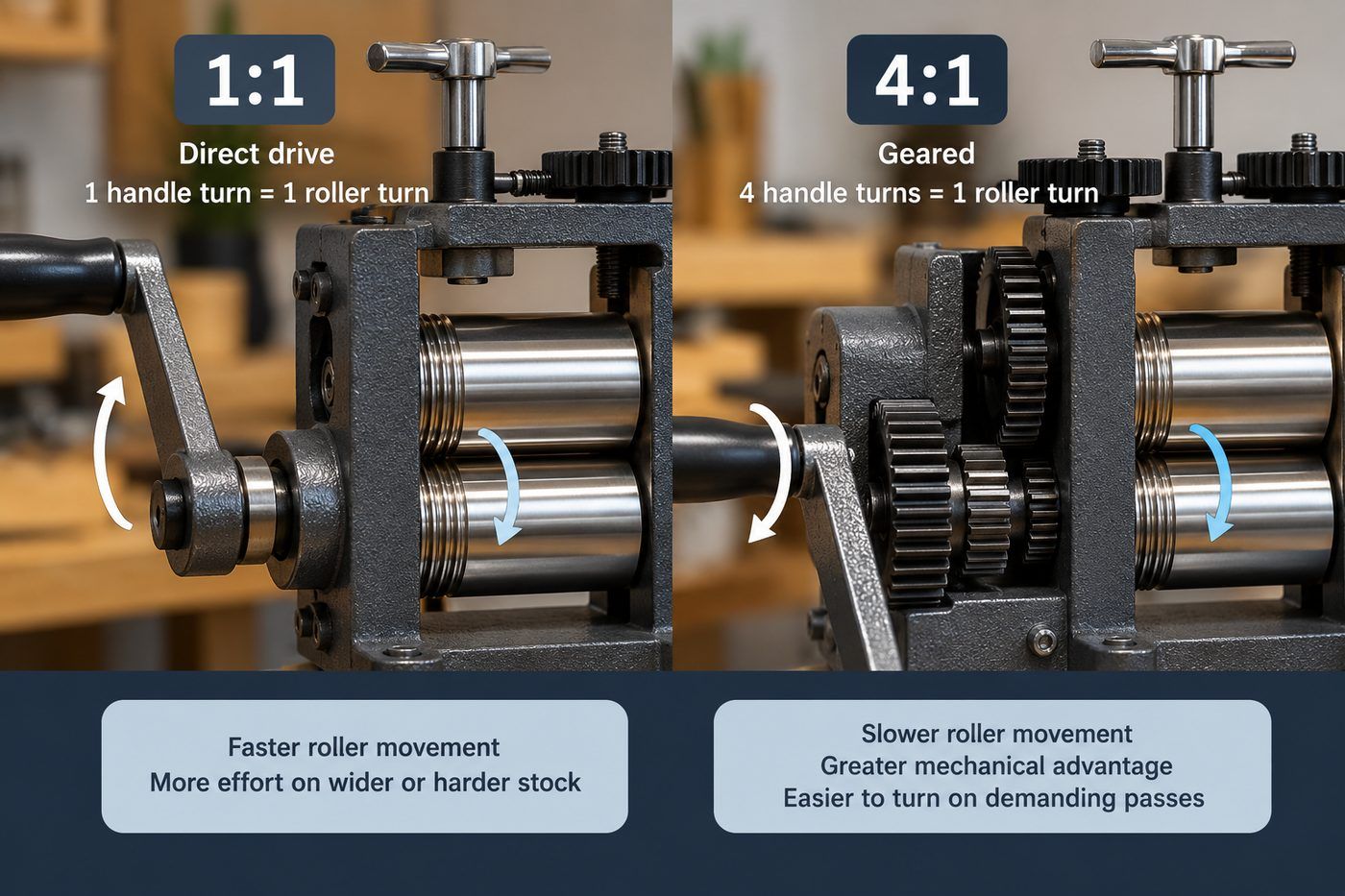
Explainer · Rolling & Forming
Learn what 1:1, 2:1 and 4:1 rolling mill gear ratios mean, how reduction gearing changes torque and handle effort, and whether a geared rolling mill is worth it.
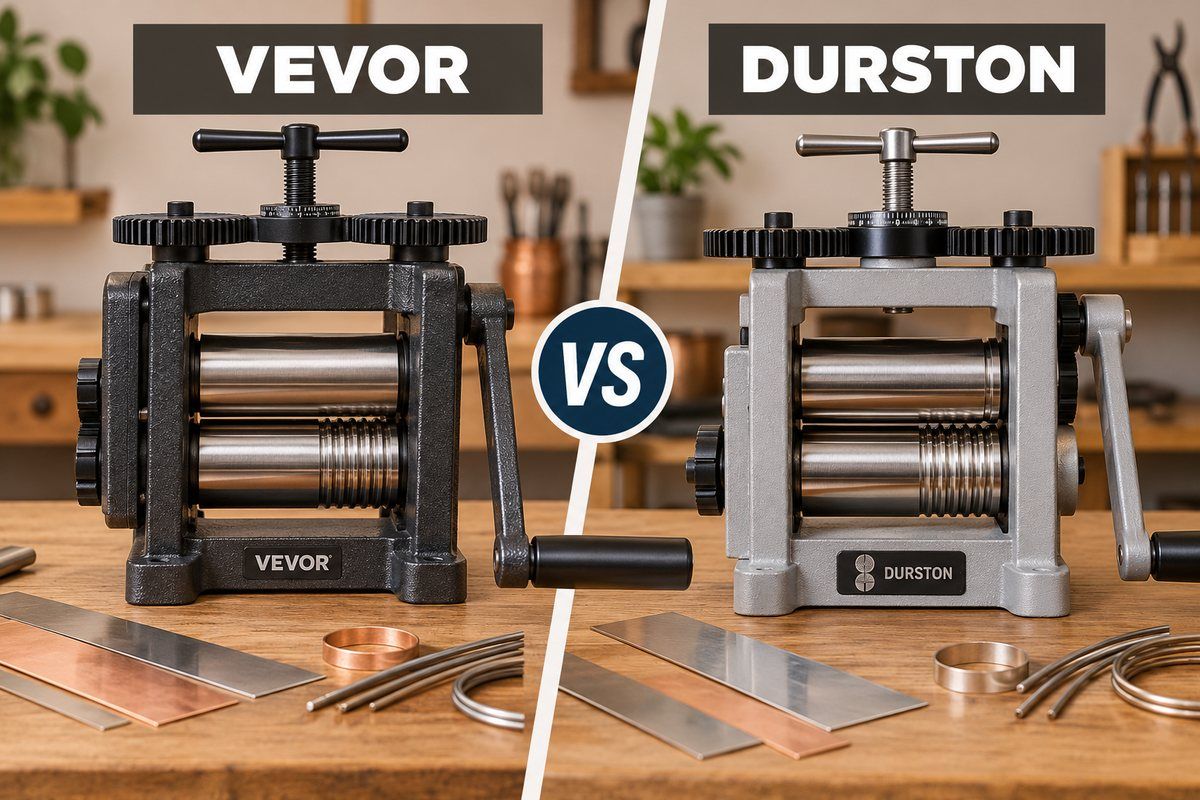
Comparison · Rolling & Forming
Compare VEVOR and Durston rolling mills on gearing, roller finish, alignment, usable width, durability and support to decide whether a premium mill is worth the extra cost.