Explainer · Rolling & Forming
What Size Rolling Mill Do I Need for Jewelry Making?
How to choose rolling mill size for jewelry making — usable flat width vs roller width, 80 vs 110 vs 130 mm mills, cuffs, texture plates and bench space.
Rolling & FormingExplainer
Learn what 1:1, 2:1 and 4:1 rolling mill gear ratios mean, how reduction gearing changes torque and handle effort, and whether a geared rolling mill is worth it.
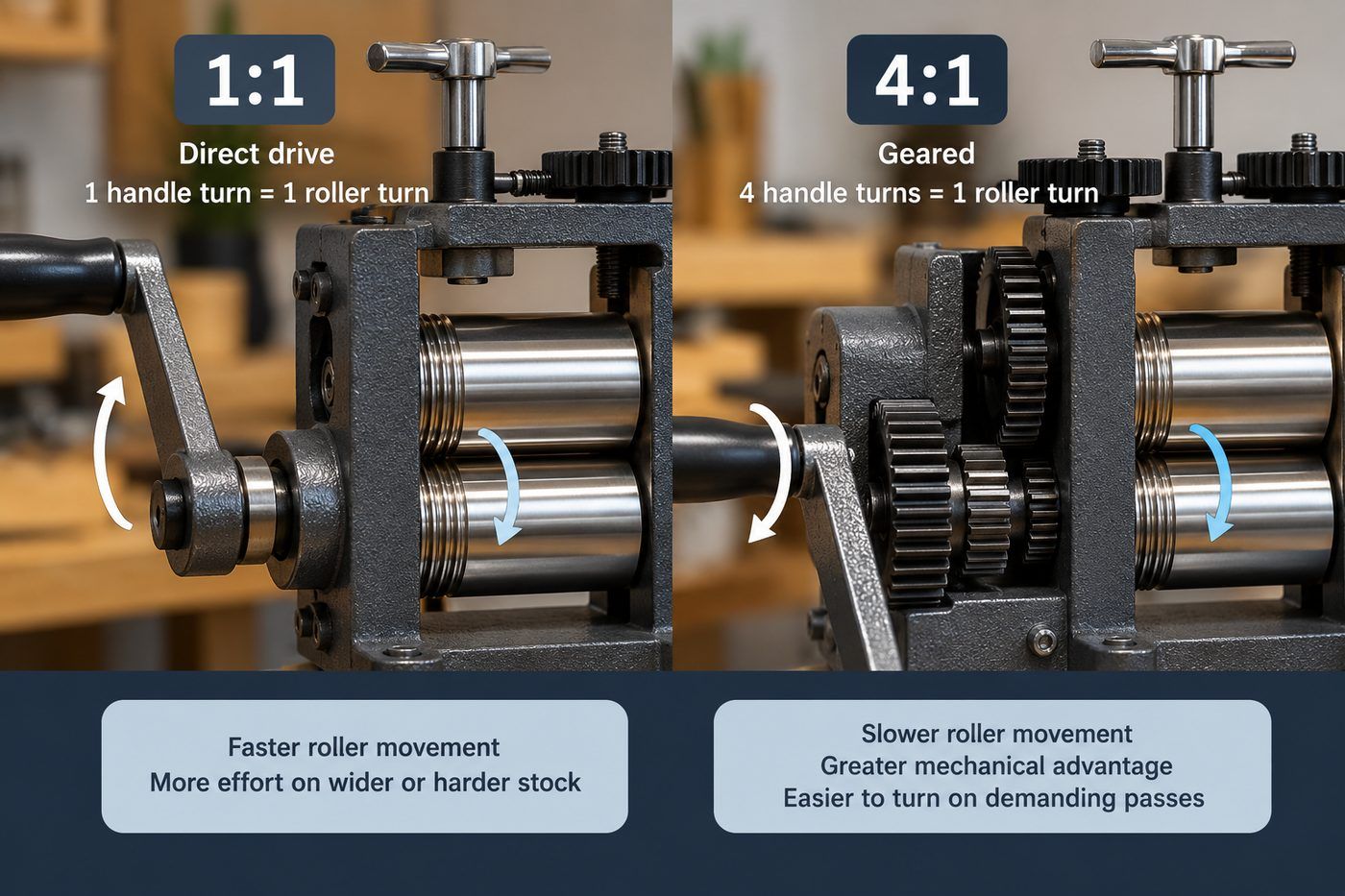
The gear ratio is one of the most important specifications on a manual jewelry rolling mill, but the numbers are easy to misunderstand.
A mill advertised as 4:1 geared does not mean that it rolls metal four times thinner, accepts four times more material or produces four times as much pressure. The ratio describes the relationship between the handle and the rollers.
Reduction gearing trades speed for mechanical advantage.
That matters because squeezing metal between two rollers can require considerable torque, especially when you are rolling wider sheet or taking a meaningful reduction in thickness.
Quick answer
A rolling mill gear ratio tells you how much the handle rotation is reduced before it reaches the rollers. With a typical 4:1 geared rolling mill, the handle turns about four times for one revolution of the driven roller. The reduction increases the torque available at the rollers, so demanding passes require less effort, although you need more handle turns to move the same length of metal through the mill.
Think of the ratio as a trade between roller speed and turning effort.
On a simple 1:1 direct-drive rolling mill, one revolution of the handle produces approximately one revolution of the driven roller.
On a 4:1 reduction-geared mill, approximately four handle revolutions produce one revolution of the roller.
The rollers therefore rotate more slowly for a given handle speed, but considerably more torque is available at the roller shaft.
In simplified terms:
| Gear ratio | Approximate handle turns | Roller revolutions | Practical effect |
|---|---|---|---|
| 1:1 | 1 | 1 | Fast roller movement, least mechanical advantage |
| 2:1 | 2 | 1 | Moderate reduction and increased torque |
| 4:1 | 4 | 1 | Slower rollers, substantially greater mechanical advantage |
| 5:1 | 5 | 1 | Still more reduction, but more handle turns per pass |
The exact arrangement varies between manufacturers, so the specification or manual for the individual mill should take priority.
The gearbox does not create energy. It exchanges rotational speed for torque.
Torque is the twisting effect that turns the rollers.
When the gears reduce roller speed, the torque delivered to the roller shaft increases. That gives you greater mechanical advantage when the metal resists deformation.
A simplified ideal relationship is:
output torque ≈ input torque × gear ratio
So, in an ideal frictionless system, a 4:1 reduction could provide roughly four times the torque at the output shaft.
Real rolling mills are not frictionless. Energy is lost through the gears, bearings or bushings and other moving parts, which means the actual multiplication is lower.
For choosing a jewelry rolling mill, however, the important practical point is simpler:
higher reduction gearing usually means less force required at the handle, at the cost of turning the handle more times.
The difference becomes easiest to understand by imagining the same piece of metal being rolled through two otherwise similar mills.
With a direct-drive mill, the rollers move relatively quickly as you turn the handle. During an easy pass this can feel convenient.
As rolling resistance increases, however, you have to provide the necessary torque yourself through the handle.
A geared mill puts a reduction mechanism between you and the rollers. You make more revolutions with the handle, but each revolution requires less effort.
| If you… | Choose | Why |
|---|---|---|
| Occasional light rolling of narrow stock | Direct drive can be sufficient | The rolling load may be low enough that additional reduction is unnecessary. |
| Regular sheet rolling | Geared mill | Reduction gearing makes higher rolling loads more manageable. |
| Wider sheet | Geared mill | More material is being deformed across the roll width, increasing the required rolling load. |
| Frequent workshop use | Geared mill | Lower handle effort can reduce fatigue over repeated passes. |
| Small reductions in soft, narrow material | Either can work | The difference in effort may be relatively small under light loads. |
| Maximum speed for very light work | Direct drive | One handle revolution produces more roller movement. |
Not necessarily.
This is one of the most important distinctions when comparing specifications.
A 4:1 gear ratio describes the gear reduction, not the total effort required from the jeweler.
The force you experience at the handle is affected by several other factors.
A longer handle provides more leverage.
Two mills with the same 4:1 gearbox can therefore feel different if one uses a significantly longer crank.
The diameter of the rolls influences the geometry and torque involved in deforming the metal.
Gear ratio should therefore not be assessed independently of roller dimensions.
Rolling a narrow strip and rolling a broad sheet are very different loads.
As the width of the metal being deformed increases, the rolling force required generally increases too.
This is one reason gearing becomes particularly useful on mills intended for wider sheet.
Copper, silver, gold and other metals do not all resist deformation in exactly the same way.
Work-hardened metal can also become progressively more difficult to roll until it is appropriately annealed.
Trying to make a large thickness reduction in a single pass creates a much greater load than making a smaller reduction.
A gearbox can make the handle easier to turn, but it does not mean the mill should be forced through excessive reductions.
Follow the mill manufacturer’s operating guidance and use appropriate reductions for the material being worked.
Bearings or bushings, gear alignment, lubrication and general manufacturing quality all influence mechanical losses.
For this reason, comparing two rolling mills purely by their stated gear ratios can be misleading.
A direct-drive rolling mill, sometimes described as an ungeared mill, does not use a reduction gearbox between the crank and the driven roller.
In the simplest arrangement, the crank effectively turns the roller shaft directly.
This gives direct-drive mills two obvious characteristics:
Fewer handle turns. The rollers travel farther for every revolution of the crank.
Less mechanical advantage. When rolling resistance increases, more effort is required from the person turning the handle.
That does not automatically make direct-drive mills poor tools.
For occasional work with small pieces of relatively easy-to-roll metal, a well-made direct-drive mill may be entirely adequate.
The trade-off becomes more noticeable as your work becomes larger or more demanding.
The advantage of reduction gearing is most noticeable when the rolling load rises.
A mill may have enough roller width to accept a broad sheet, but that does not mean rolling the full width will be effortless.
Wider material places more metal between the rolls at once.
If you expect to make sheet regularly, reduction gearing becomes particularly valuable.
Making sheet from thicker stock typically involves multiple passes through progressively smaller roll gaps.
Even if each individual pass is manageable, repeatedly turning a direct-drive mill can become tiring.
A geared mill reduces the effort required for those repeated passes.
For someone who brings out a mill only occasionally, gearing may not feel like an essential feature.
If rolling becomes a regular part of fabrication, the ergonomic difference becomes much more significant.
That is why gear reduction deserves more weight when comparing a mill for long-term use rather than simply looking for the least expensive machine.
Not by itself.
A high gear ratio gives you greater mechanical advantage, but it does not tell you how much load the entire mill can safely withstand.
A rolling mill also depends on:
A heavily geared but poorly constructed mill is not automatically stronger than a lower-ratio, better-engineered machine.
This distinction matters when shopping online because gear ratio is an easy specification to advertise.
It should be treated as one part of the mill’s design rather than a quality score.
A 4:1 reduction gearbox is common on current manual jewelry rolling mills.
For example, Durston specifies 4-to-1 gearboxes across several of its manual DRM and Agile models, while Pepetools also lists 4:1 gearing on a number of its manual mills.
There is a practical reason ratios in this range make sense for hand-operated mills.
Enough reduction is provided to make substantial rolling loads manageable, while the operator can still move material through the rolls without an excessive number of crank revolutions.
That makes 4:1 a useful reference point when comparing manual mills.
It does not, however, mean every good mill must use exactly 4:1 gearing.
No.
Suppose one mill has 4:1 reduction and another has 6:1.
The 6:1 mill gives greater theoretical torque multiplication, but the rollers also move more slowly for every turn of the handle.
If the work does not need the additional torque, the extra reduction simply means more cranking.
The goal is therefore not to find the largest ratio possible.
It is to have enough mechanical advantage for the work the mill is designed to perform.
For typical jewelry fabrication, the complete design of the mill matters considerably more than choosing between two relatively close reduction ratios.
When two rolling mills are on your shortlist, don’t compare the gearbox specification in isolation.
Check these specifications together:
Look for the actual reduction ratio, such as 4:1.
Be cautious when a listing says only “geared” or “high reduction” without giving a ratio.
A 100 mm mill and a 150 mm mill can both have 4:1 gearing but be designed for substantially different workloads.
See our guide to rolling mill sizes if you are deciding how much roll width you actually need.
Larger rolls change the geometry of the mill and should be considered alongside the gearbox.
A longer crank increases leverage, while the shape and grip influence how comfortable repeated turning feels.
The maximum roll gap tells you what thickness can physically enter the mill.
It should not be confused with how large a reduction you should attempt in one pass.
A gearbox is only useful if the rest of the machine can handle the loads involved.
Look at the mill as a complete mechanical system rather than buying on gear ratio alone.
They answer different questions.
Roller width determines what size of sheet or working area the mill can accommodate.
Gear ratio influences how much mechanical advantage you have when turning those rollers.
If you buy a mill that is too narrow, additional gearing cannot make your sheet fit.
If you buy a sufficiently wide mill but choose a design that requires excessive effort for your typical workload, the available width becomes less useful.
For that reason, choose the appropriate mill size first, then compare gearing and construction among machines that meet that requirement.
For a beginner buying a manual rolling mill that they expect to keep using, a reduction-geared mill is generally the more versatile design.
You may not notice the advantage while rolling a narrow strip of annealed metal with a light reduction.
You are much more likely to appreciate it later when you start:
That makes gearing a feature worth considering for future use, not simply for the first projects you intend to make.
At the same time, it is usually better to buy a well-built mill with suitable rolls and adequate width than to choose an otherwise inferior machine solely because it advertises a larger gear ratio.
The easiest rule is:
higher gear reduction = easier turning, slower roller rotation.
A direct-drive mill sits at the speed end of that trade-off.
A reduction-geared mill moves toward the mechanical-advantage end.
Neither changes the fundamental process: the rollers still squeeze the metal as it passes through a controlled gap.
The gearbox simply changes how much effort you need to provide to make those rollers turn.
For most people comparing manual jewelry rolling mills, reduction gearing is a meaningful feature rather than a marketing extra.
A ratio such as 4:1 means roughly four handle rotations for one roller rotation. In return for the additional turns, the gearbox multiplies the torque available at the rollers and makes higher rolling loads easier to manage.
Direct-drive mills remain workable for lighter jobs, but the difference becomes more apparent as stock gets wider, rolling loads increase or the mill is used repeatedly.
Don’t choose a mill from its ratio alone, though. Consider gear ratio, roller width, roller diameter, handle leverage and overall construction together.
If you are still choosing the physical size of the machine, start with what size rolling mill you need. Once you know the size and roll configuration you want, compare suitable models in our rolling mill buying guide.
A 4:1 reduction normally means the handle turns four times for approximately one revolution of the driven roller. The gearbox increases the torque available at the rollers while reducing their rotational speed, making demanding passes easier to turn.
For most regular sheet and wire work, 4:1 gearing is more comfortable because it provides greater mechanical advantage. A 1:1 direct-drive mill turns the rollers faster but requires more effort when the rolling load increases.
No. Direct-drive mills are mechanically simpler and can work well for light jobs, narrow material and small reductions. Their disadvantage becomes more noticeable as the stock gets wider, thicker or harder to deform.
Not exactly. A 4:1 reduction provides an ideal torque multiplication of roughly four before mechanical losses, but the effort you feel also depends on handle length, roller diameter, friction, material, stock width and reduction per pass.
No. Higher reduction makes the rollers easier to turn but also makes each roller revolution require more handle turns. Beyond a certain point, extra reduction may make ordinary rolling unnecessarily slow.
A reduction-geared mill is generally the more comfortable choice for regular jewelry work, particularly when rolling sheet or using the mill frequently. Gear ratio should still be considered alongside roller width, roller diameter, build quality and the type of work you expect to do.
We have not personally used every product in this guide. Recommendations are based on specifications, manufacturer documentation, specialist references and owner experiences.
Full details: how we review and research tools and oureditorial policy.
Explainer · Rolling & Forming
How to choose rolling mill size for jewelry making — usable flat width vs roller width, 80 vs 110 vs 130 mm mills, cuffs, texture plates and bench space.
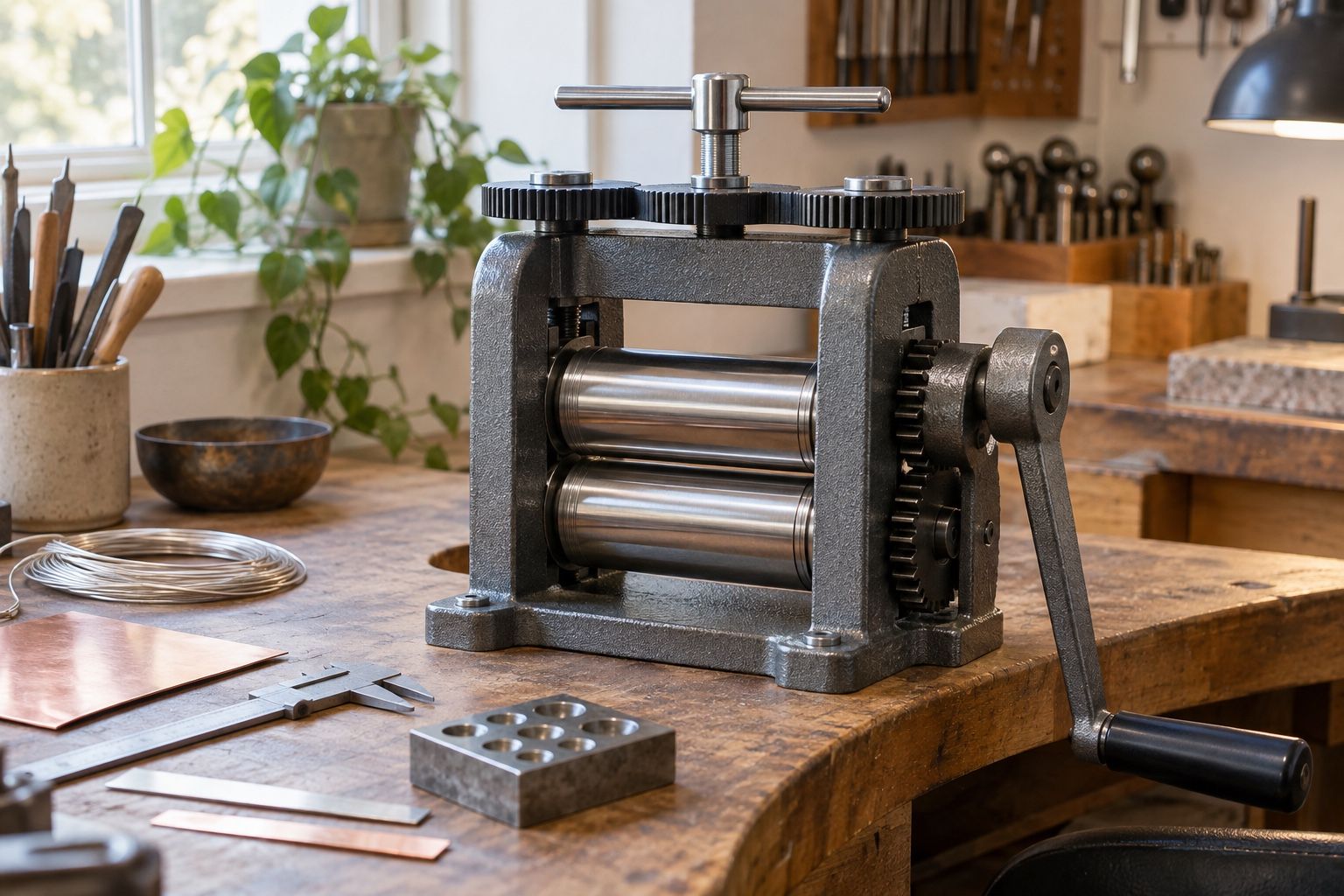
Buying guide · Rolling & Forming
Choose the right jewelry rolling mill by roller width, configuration, gearing and bench space, with a research-based look at budget and professional options.
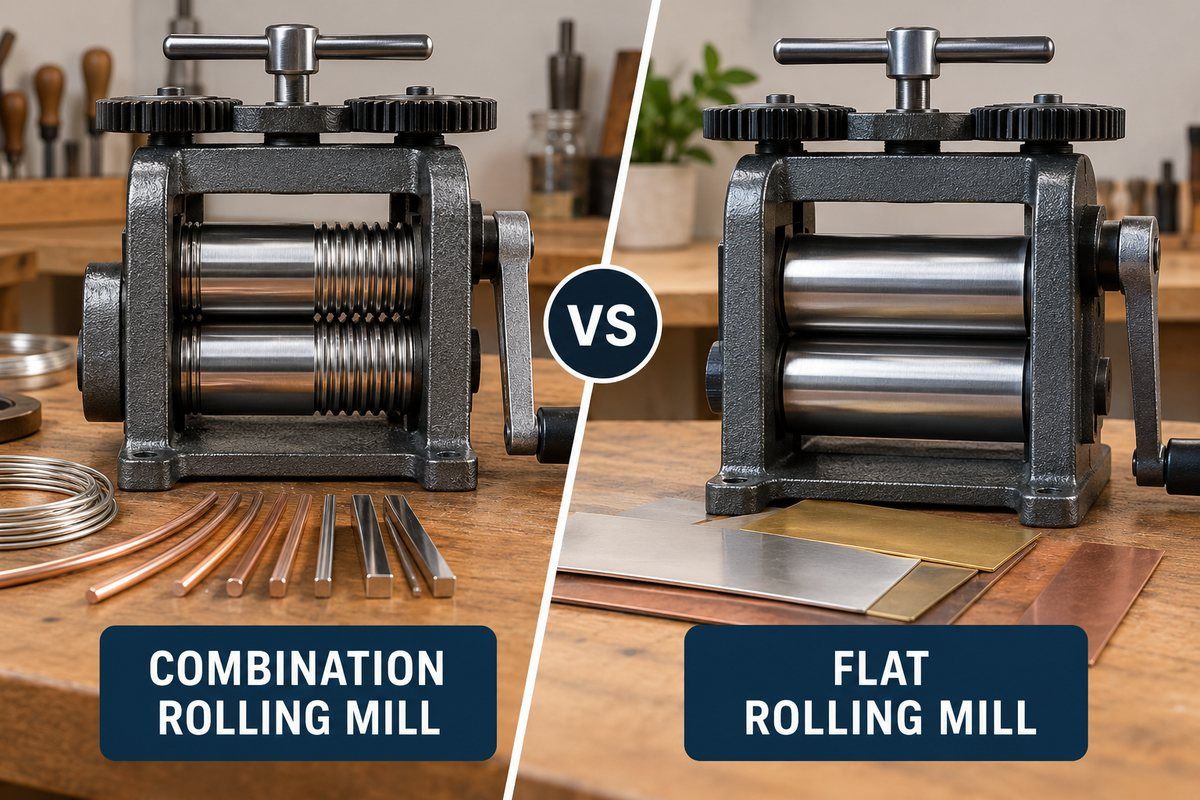
Comparison · Rolling & Forming
Combination vs flat rolling mills compared for jewelry making — including usable sheet width, wire grooves, versatility and which type is better for your bench.
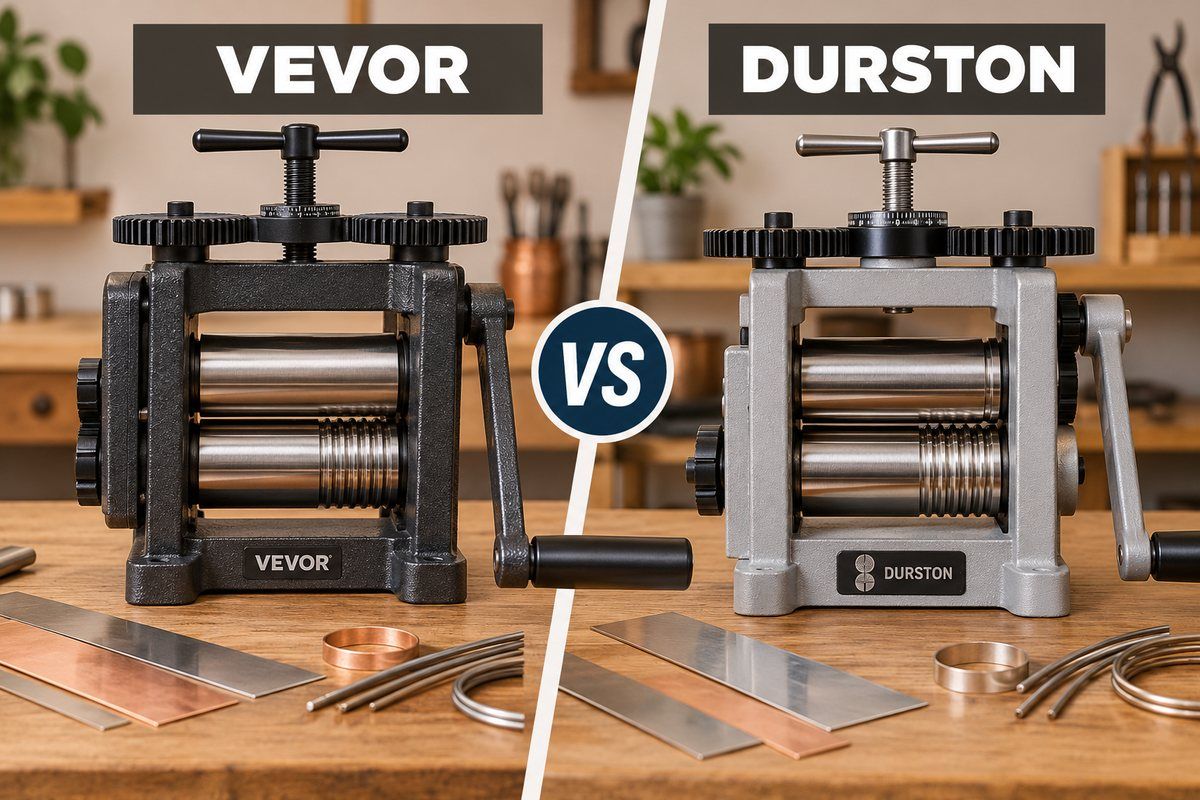
Comparison · Rolling & Forming
Compare VEVOR and Durston rolling mills on gearing, roller finish, alignment, usable width, durability and support to decide whether a premium mill is worth the extra cost.