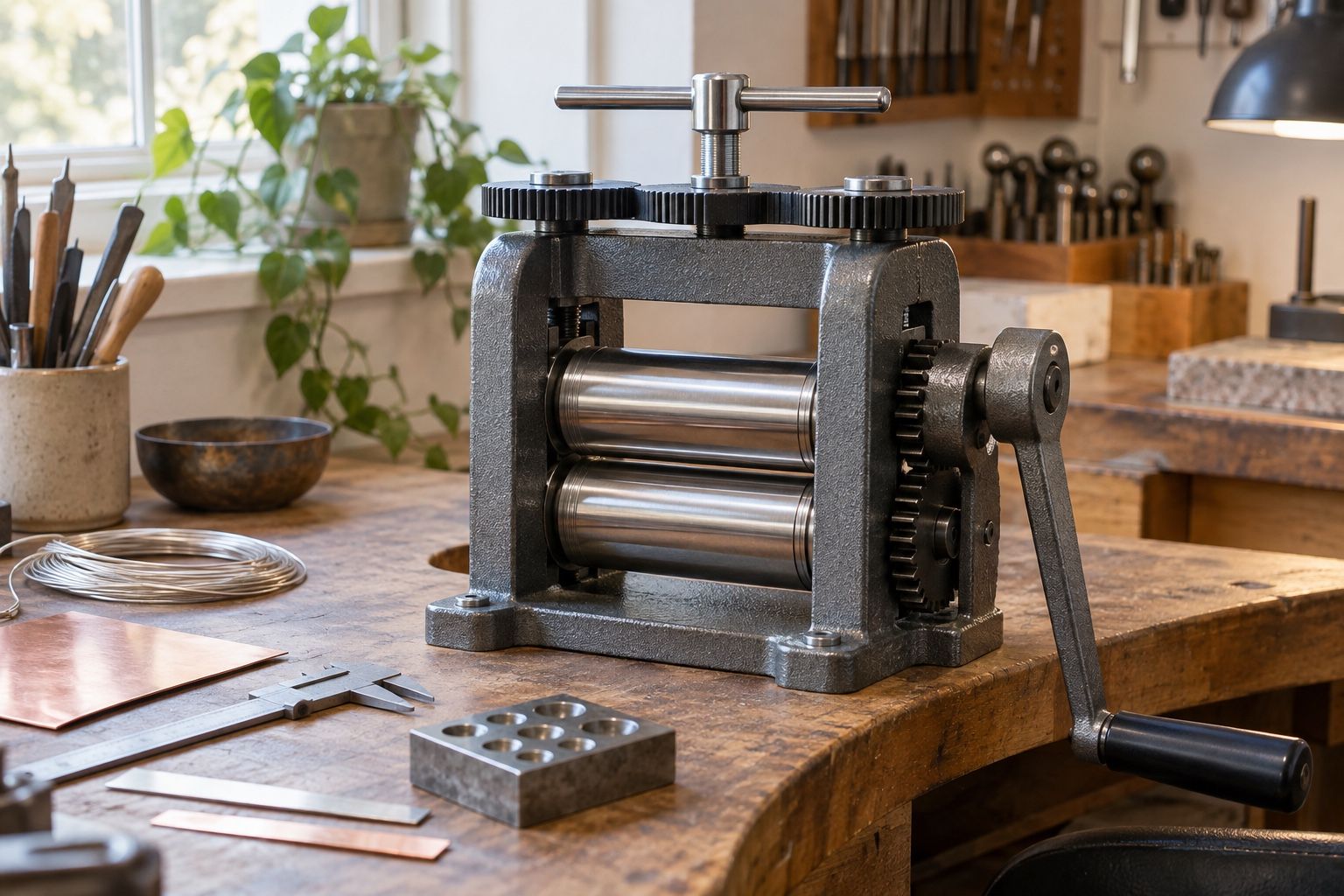
Choose the right jewelry rolling mill by roller width, configuration, gearing and bench space, with a research-based look at budget and professional options.
A rolling mill can turn ingots into sheet, reduce wire, create repeatable texture and make scrap useful again. It is also heavy, space-hungry and one of the costliest manual machines on a home jewelry bench. The best choice is therefore not the mill with the longest feature list—it is the smallest well-supported mill that comfortably handles the work you actually make.
Quick answer
What is the best rolling mill for a home jeweler?
For most home jewelers, the practical starting point is a manual, geared combination mill with 100–110 mm rollers.
That format handles sheet and square wire without taking over the bench, while reduction gearing makes each pass easier
to control. Choose a smaller 76–80 mm mill only if space and budget are tight; choose a wider flat mill if sheet width
or roll printing is the priority.
The short version: match the mill to the work
Your work
Start with
Trade-off to accept
Rings, small components, sheet and square wire
100–110 mm geared combination mill
The grooved section reduces the usable width for sheet.
Small pieces on a very tight bench
76–80 mm compact mill
Less capacity and, on some models, direct drive rather than reduction gearing.
Wide sheet, pattern plates and roll printing
100–130 mm flat mill
Wire must be formed another way or with optional side rollers.
Frequent production work or a shared studio
Heavier geared mill with strong parts support
Higher purchase price and a more demanding mounting setup.
Decide these four things before comparing brands
1. Usable flat width
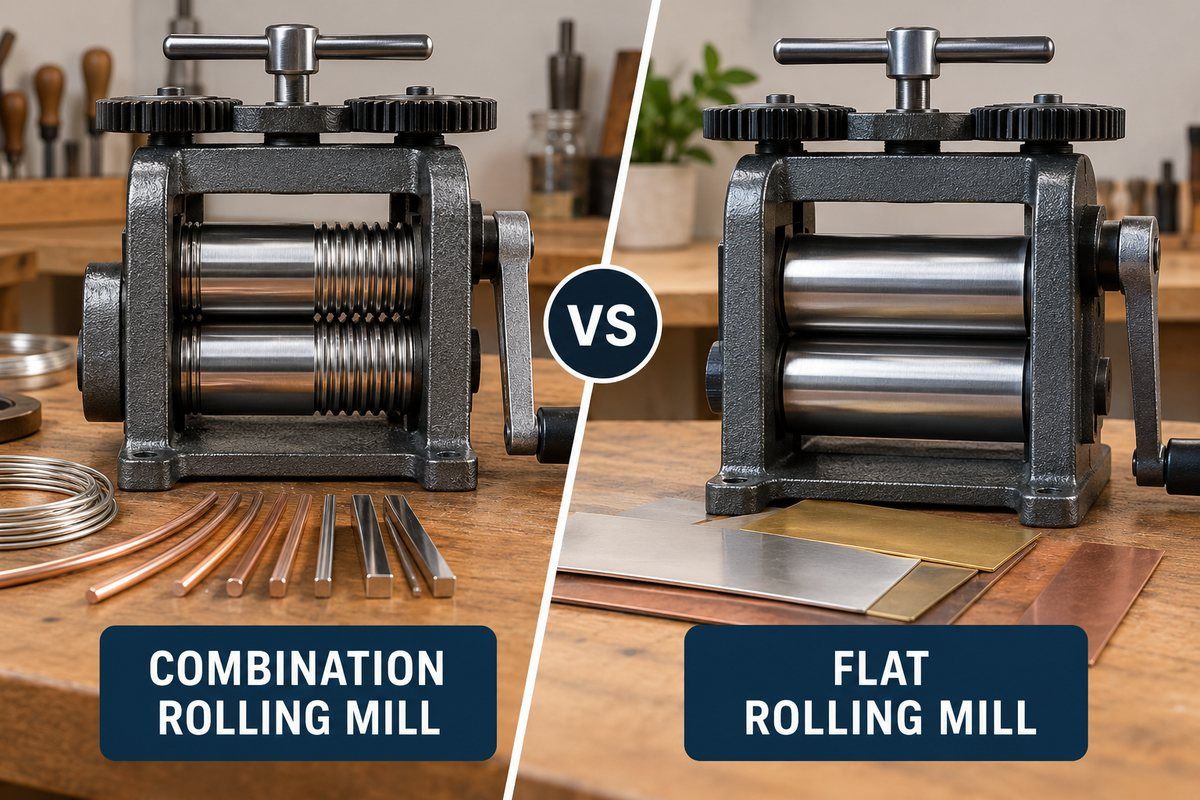
The number in a model name often describes total roller length, not the amount of smooth roller available for sheet. On a combination mill, wire grooves occupy part of that span. A 110 mm combination mill can therefore have a much narrower flat working area than a 110 mm flat mill.
Measure the widest blank, strip or texture plate you realistically expect to roll, then compare that dimension with the flat area, not merely the headline roller width. Our guide to choosing rolling-mill size works through the decision in more detail.
2. Combination, flat or wire rollers
Combination rollers divide the main rollers between a smooth section and shaped wire grooves. They are the most flexible one-machine choice for a home bench.
Flat rollers devote the full width to sheet and roll printing. They are the better fit when wide, clean sheet is the priority.
Wire rollers offer more groove sizes but are specialized. They suit makers who regularly produce square wire and already have another way to roll sheet.
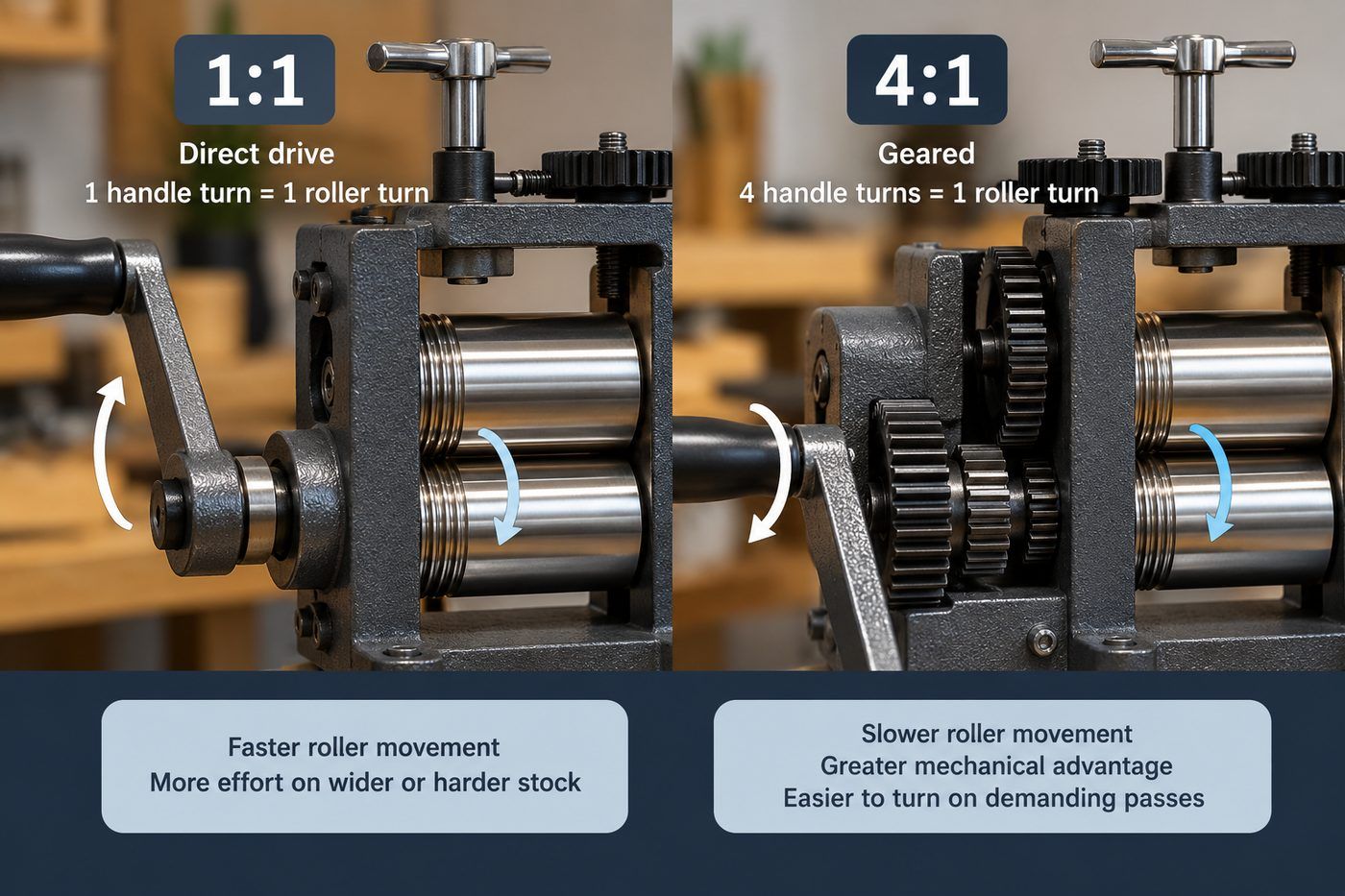
A 4:1 reduction gearbox means the handle turns four times for approximately one turn of the driven roller. It trades speed for leverage: each pass takes more handle movement, but less force. That is usually a good bargain on a manual mill, particularly as sheet gets wider or the alloy work-hardens.
Gear-ratio labels do not tell the whole story. Handle length, roller diameter, frame stiffness, bearing quality and correct annealing also affect how a mill feels. See what rolling-mill gear ratios mean for the mechanics.
4. Bench, mounting and service access
A rolling mill works by resisting substantial force. A light table that twists or walks across the floor makes rolling harder and less predictable. Before buying, confirm:
the machine’s weight and overall dimensions, including the handle’s sweep;
the mounting-hole pattern and whether bolts can pass through the bench or stand;
clear space to feed long strip from both sides;
access to adjustment, cleaning and lubrication points; and
whether rollers, gears and other service parts are obtainable for the exact model.
Recommended rolling mills for home jewelers
The right choice depends more on usable flat width, roller configuration and gearing than on brand alone. The first two mills are compact combination models suited to smaller work and tighter budgets. Choose either only if its actual flat section is wide enough for the pieces you make.
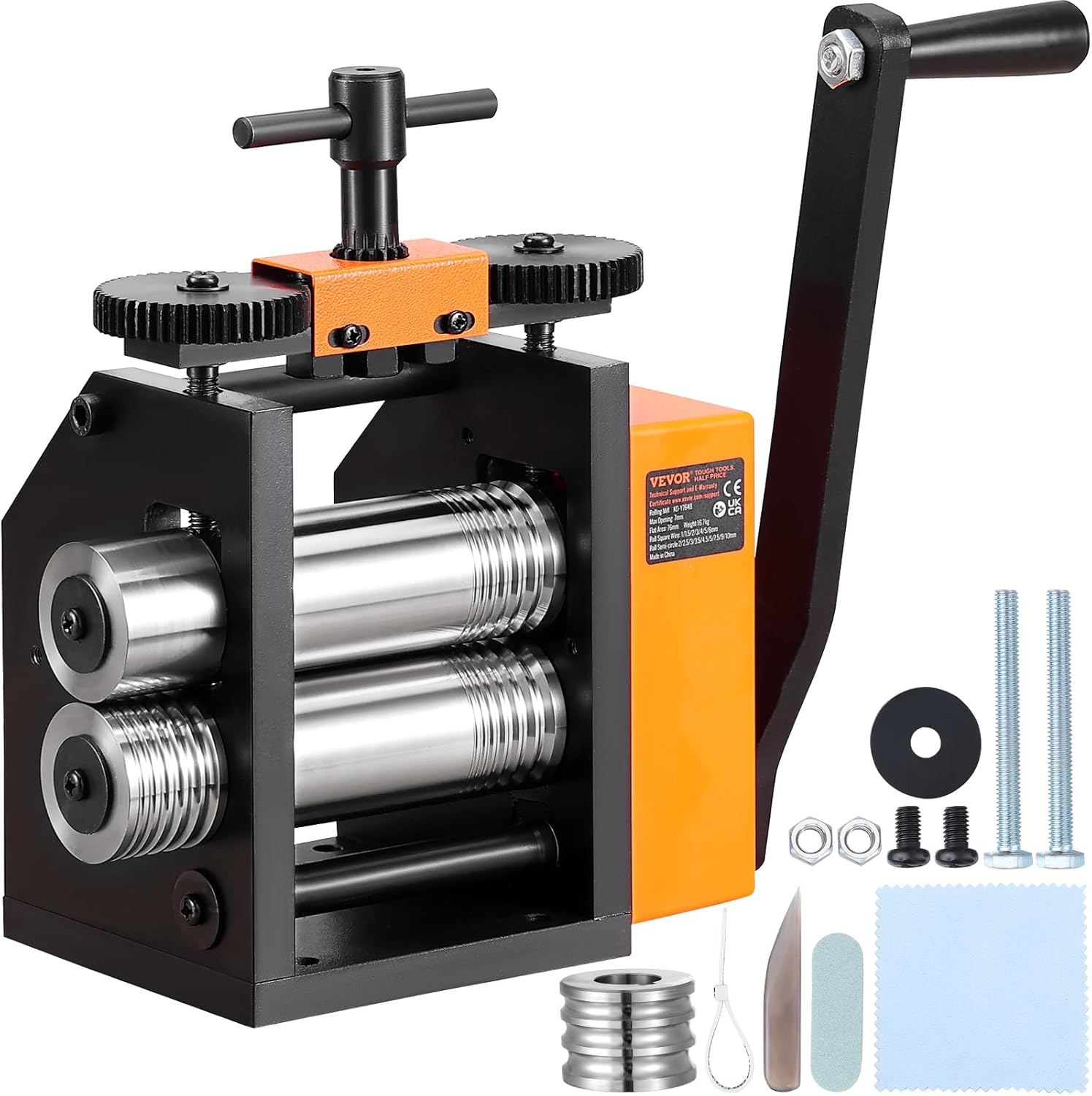
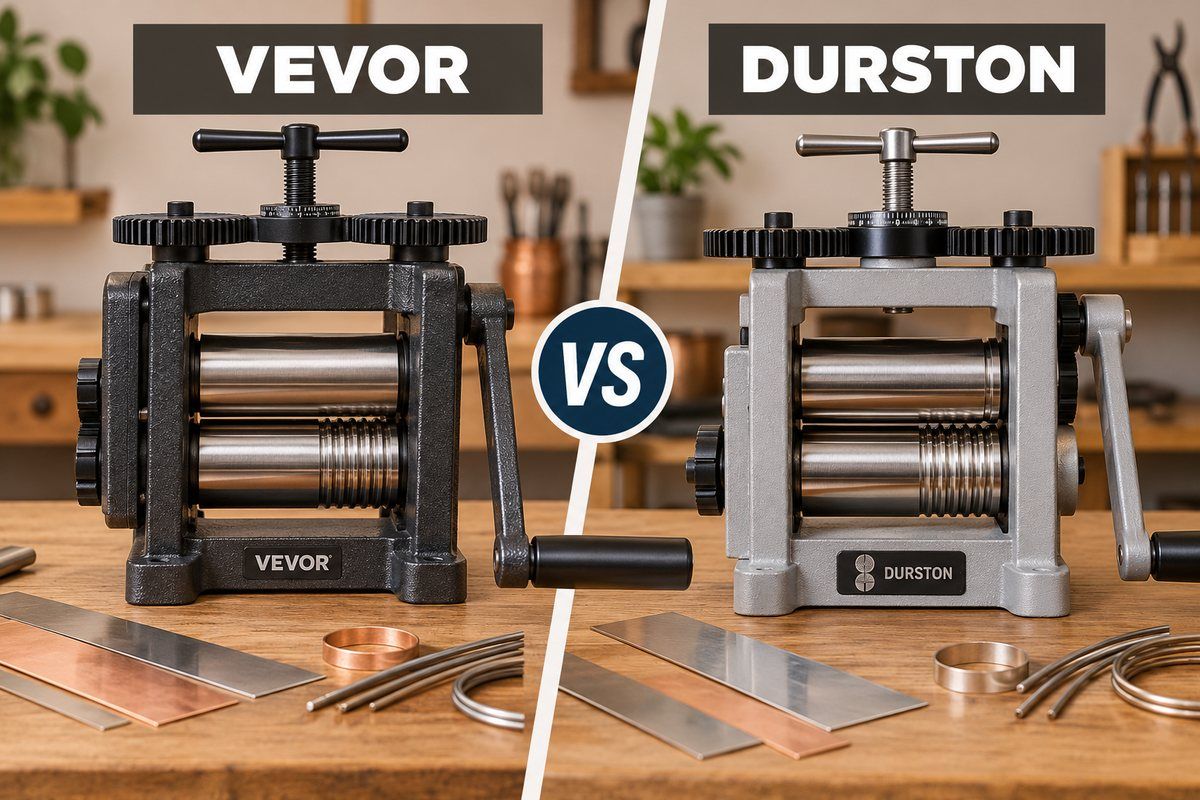
Choose the VEVOR when purchase price and a compact footprint matter most. Its 76 mm flat roller and separate square and
half-round sections cover common small jewelry work, while the 7 mm stated opening accommodates thicker starting stock.
The compromise is leverage: its 2:1 reduction is less helpful than the 4:1 gearing on the Lakimi.
Best for: Budget-conscious beginners making rings and small components who can work within a 76 mm sheet width.
Specs, strengths and limitations
Roller width
76 mm
Flat rolling area
76 mm flat roller
Wire grooves
7 square sizes; 9 half-round sizes
Gear ratio
2:1 reduction
Maximum opening
7 mm
Strengths
Exact Amazon.com listing and model identity were matched
Flat, square-wire and half-round capability in a compact footprint
Lower entry price than the geared specialist mills in this guide
Limitations
76 mm width limits wider sheet and texture work
2:1 gearing provides less leverage than a 4:1 or 5:1 mill
Inspect roller finish and alignment immediately after delivery
The LK-RM06 is the stronger fit when lower handle effort matters. Its 4:1 gearing is the clearest advantage over the
VEVOR, but only 40 mm of the nominal 90 mm roller width is available for flat sheet. That makes it a wire-oriented
combination mill rather than a good choice for cuffs, wide texture plates or larger sheet projects.
Best for: Home jewelers who want easier 4:1 cranking and can accept a narrow flat area in exchange for wire grooves.
Specs, strengths and limitations
Roller width
90 mm
Flat rolling area
40 mm
Wire grooves
Square and half-round grooves
Gear ratio
4:1 reduction
Maximum opening
4 mm
Strengths
4:1 gearing requires less force than the compact 2:1 VEVOR
Combination layout supports sheet, square wire and half-round profiles
Exact model and ASIN were matched on Amazon.com
Limitations
Only 40 mm of the 90 mm roller is available for flat sheet
Maximum opening is 4 mm rather than the 7 mm stated for the VEVOR
Shorter manufacturer track record than PEPETOOLS or Durston
These two mills devote their working width to sheet and texture work rather than built-in square-wire grooves. The PEPETOOLS is the more compact step up, while the wider, heavier Durston is better suited to frequent studio work. In either case, confirm the exact model, seller, delivery terms and support arrangements before purchasing.
A USA-made, reduction-geared flat mill with the full 90 mm roller width available for sheet and roll printing. Amazon lists the exact 18700A model and currently exposes buying options, although it may not show a featured offer.
Best for: Jewelers who prioritize clean sheet and roll printing over built-in wire grooves.
Specs, strengths and limitations
Roller width
90 mm
Flat rolling area
90 mm
Wire grooves
None
Gear ratio
4:1 reduction
Maximum opening
5 mm
Strengths
Full roller width is available for sheet and textures
4:1 reduction gearing lowers handle effort
Manufacturer publishes detailed model specifications and parts support
Limitations
No built-in square-wire grooves
Only 90 mm of sheet capacity
Amazon may present third-party buying options instead of a featured offer
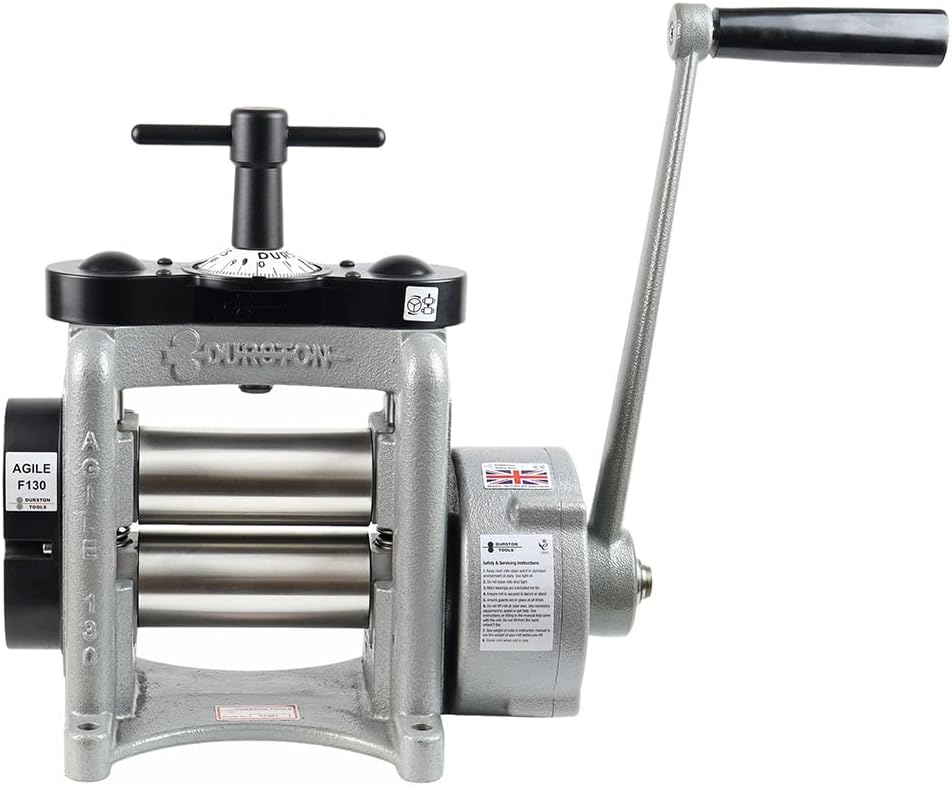
A heavy 130 mm manual flat mill with 5:1 reduction gearing. The exact Agile F130 model is listed on Amazon, with offer visibility depending on the shopper's delivery location.
Best for: Frequent studio work, wider sheet and roll printing where maximum flat width matters more than wire grooves.
Specs, strengths and limitations
Roller width
130 mm
Flat rolling area
130 mm
Wire grooves
None
Gear ratio
5:1 reduction
Maximum opening
6 mm
Strengths
Wide 130 mm flat working area
5:1 gearing provides substantial leverage
Manufacturer documentation and replacement parts are readily traceable
Limitations
No built-in square-wire grooves
Heavy machine that needs a rigid permanent mounting point
Amazon offer visibility and delivery eligibility vary by location
Budget and established mills: where the money tends to go
Decision factor
Budget import
Established manufacturer
Initial cost
Lower entry price
Higher upfront investment
Setup
Allow time to inspect, clean and adjust
Usually better documented and more consistent out of the box
Specifications
Listings may vary by seller or batch
Exact model documentation is generally easier to trace
Parts and support
Confirm before purchase
A clearer service and replacement-parts path is more common
Best fit
Occasional use and a firm spending limit
Frequent use, repeatability and a longer upgrade horizon
A low price does not automatically make a mill poor value, and a premium badge does not guarantee the right configuration. Budget models ask the buyer to accept more uncertainty: inspect the rollers closely, verify that the gap stays parallel, and confirm the exact machine rather than relying on a seller’s reused title or photos. Established mills cost more partly because documentation, consistent model identity and service support are easier to evaluate.
Whether buying new or used, check the parts that directly affect every pass.
Roller faces: Look for rust, pits, scratches, dents or machining marks. Damage here can emboss the metal repeatedly.
Parallel adjustment: Close the rollers on a clean test strip at both sides. Uneven marking can indicate that the gap is not parallel.
Gear and handle movement: Rotation should feel consistent rather than binding at one point. Some backlash is normal; grinding or a pronounced tight spot is not.
Frame and bearing blocks: Look for cracks, distortion and loose fasteners. The rollers need rigid support to remain aligned under load.
Model identity: Match the nameplate, roller layout and documented dimensions to the listing. Similar-looking mills can have different widths, gearing and groove patterns.
Parts path: Confirm who supplies replacement gears, handles, bearings or rollers—and whether those parts fit the exact generation of the mill.
Common buying mistakes
Buying by total width alone
The usable flat section is the important measurement for sheet. A combination mill can sacrifice a large portion of its nominal width to wire grooves.
Treating “more grooves” as automatically better
Grooves are only useful if their size and shape match the wire you make. Unused grooves simply reduce flat capacity.
Underestimating the mounting problem
The machine may fit on the bench while the handle, feed path and operator do not. Tape the footprint and handle arc onto the proposed location before ordering.
Expecting one heavy pass to save time
Large reductions increase force, encourage uneven stock and work-harden the metal quickly. Controlled reductions, consistent feed direction and timely annealing are safer and more repeatable.
Comparing a verified model with a generic marketplace listing
Marketplace titles can combine widths, gear ratios and accessories from several variants. Treat the model number and exact ASIN as the identity; if either is unclear, the product still needs verification.
When a rolling mill should wait
A mill earns its space when you regularly make sheet or wire, recycle clean scrap, create texture, or need repeated gauges. It is less urgent if you mostly assemble findings, work from ready-made wire, or are still building basic sawing, filing, soldering and finishing skills.
For many new benches, a saw, reliable measurement tools, a soldering setup and a flex shaft change day-to-day work sooner. Use the home jewelry bench setup guide to prioritize the whole bench rather than one appealing machine.
Bottom line
Start with the work, not the logo. For a typical home jeweler making rings, small components, sheet and square wire, a 100–110 mm geared combination mill is the sensible default. Move smaller only for a real space constraint; move to a flat or wider mill because your sheet work demands it. Then compare exact models on usable flat width, gearing, weight, mounting, documentation and parts—not on marketplace photos or an unverified feature list.
Frequently asked questions
What size rolling mill is best for a home jeweler?
For most home jewelers, a geared mill with 100–110 mm rollers offers the best balance of usable capacity, bench space and effort. A compact 76–80 mm mill can suit small work, while 130 mm and wider machines make sense when wider sheet is a regular requirement.
Do I need a rolling mill as a beginner?
Not necessarily. If you buy sheet and wire in the gauges you use and do not recycle scrap, a rolling mill can wait. It becomes more useful when you want to make your own stock, reuse scrap, texture metal or repeat production work.
Is a geared rolling mill worth it?
Usually. Reduction gearing lowers the effort required at the handle, especially with wider sheet or harder alloys. The trade-off is that the handle turns several times for one revolution of the rollers.
Should I buy a combination or flat rolling mill?
Choose a combination mill if you need one machine for both sheet and square wire. Choose a flat mill when usable sheet width and roll printing matter more than wire grooves.
Can a rolling mill be used for texturing?
Yes. Roll printing can transfer texture from suitable materials or pattern plates, but the rollers must be protected from hard or abrasive materials that could permanently mark their surface.
Can I roll metal without annealing it?
Only for limited reduction. Rolling work-hardens many jewelry alloys, so repeated passes normally require annealing at suitable intervals. The exact schedule depends on the alloy, starting condition and amount of reduction.
We have not personally used every product in this guide. Recommendations are based on specifications, manufacturer documentation, specialist references and owner experiences.
Specifications come from manufacturer documentation where it is available.
Specialist references, supplier catalogs and owner experiences are used to understand real-world strengths and weaknesses.
We do not claim physical testing, and we do not publish scores or star ratings.
How to choose rolling mill size for jewelry making — usable flat width vs roller width, 80 vs 110 vs 130 mm mills, cuffs, texture plates and bench space.
Learn what 1:1, 2:1 and 4:1 rolling mill gear ratios mean, how reduction gearing changes torque and handle effort, and whether a geared rolling mill is worth it.
Combination vs flat rolling mills compared for jewelry making — including usable sheet width, wire grooves, versatility and which type is better for your bench.
Compare VEVOR and Durston rolling mills on gearing, roller finish, alignment, usable width, durability and support to decide whether a premium mill is worth the extra cost.